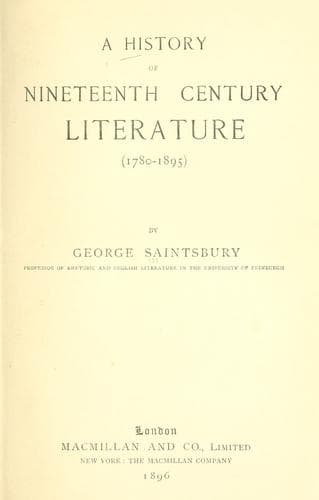
A History of Nineteenth Century Literature (1780-1895)Saintsbury, George
History
A History of Nineteenth Century Literature (1780-1895)
Saintsbury, George
English literature -- 19th century -- History and criticism
In all the work of the time, however, great and small, from
the half-unconscious inspiration of Burns and Blake to the
common journey-work of book-making, we shall find the same
character--incessantly recurring, and unmistakable afterwards if not
always recognisable at the time--of transition, of decay and seed-time
mingled with and crossing each other. There are no distinct spontaneous
literary schools: the forms which literature takes are either occasional
and dependent upon outward events, such as the wide and varied attack
and defence consequent upon the French Revolution, or else fantastic,
trivial, reflex. Sometimes the absence of any distinct and creative
impulse reveals itself in work really good and useful, such as the
editing of old writers, of which the labours of Malone are the chief
example and the forgeries of Ireland the corresponding corruption; or
the return to their study aesthetically, in which Headley, a now
forgotten critic, did good work. Sometimes it resulted in such things
as the literary reputation (which was an actual thing after a kind) of
persons like Sir James Bland Burges, Under-Secretary of State,
poetaster, connoisseur, and general fribble. Yet all the while, in
schools and universities, in London garrets and country villages, there
was growing up, and sometimes showing itself pretty unmistakably, the
generation which was to substitute for this trying and trifling the
greatest work in verse, and not the least in prose, that had been done
for two hundred years. The _Lyrical Ballads_ of 1798, the clarion-call
of the new poetry, so clearly sounded, so inattentively heard, might
have told all, and did tell some, what this generation was about to do.
FOOTNOTES:
[1] Although _The Baviad_ and _The Maeviad_ are well worth reading, it
may be questioned whether they are as amusing as their chief quarry,
_The British Album_, "containing the poems of Della Crusca, Anna
Matilda, Benedict, Cesario, The Bard, etc.," the two little volumes of
which attained their third edition in 1790. "Della Crusca," or Robert
Merry (1755-98), was a gentleman by birth, and of means, with a Harrow
and Oxford training, and some service in the army. Strange to say, there
is testimony of good wits that he was by no means a fool; yet such
drivelling rubbish as he and his coadjutors wrote even the present day
has hardly seen.
[2] I used to think these titles sprouts of the author's brain; but a
correspondent assured me that one or two at least are certainly genuine.
Possibly, therefore all are.
CHAPTER II
THE NEW POETRY
Public-domain text, read in full here on John Shaqi.
Reviews
Reviews
No reviews yet
Be the first to share your thoughts on this work.
Elsewhere in the archive
Join the Discussion
Join the discussion
Sign in to leave a comment or review.
Sign InorCreate an account