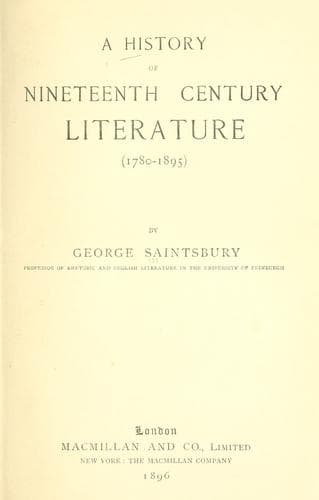
A History of Nineteenth Century Literature (1780-1895)Saintsbury, George
History
A History of Nineteenth Century Literature (1780-1895)
Saintsbury, George
English literature -- 19th century -- History and criticism
When Lord Lonsdale died in 1802, his
successor promptly and liberally settled the Wordsworth claims. The poet
soon married his cousin Mary Hutchinson; and Lord Lonsdale, not
satisfied with atoning for his predecessor's injustice, procured him, in
the year of his migration to Rydal, the office of Distributor of Stamps
for Westmoreland--an office which was almost a sinecure, and was, for a
man of Wordsworth's tastes, more than amply paid. It is curious, and a
capital instance to prove that the malignity of fortune has itself been
maligned, that the one English poet who was constitutionally incapable
of writing for bread never was under any necessity to do so. For full
sixty years Wordsworth wandered much, read little, meditated without
stint, and wrote, though never hurriedly, yet almost incessantly. The
dates of his chief publications may be best given in a note.[3] For some
years his poems were greeted by the general public and by a few of its
critical guides with storms of obloquy and ridicule; but Wordsworth,
though never indifferent to criticism, was severely disdainful of it,
and held on his way. From the first the brightest spirits of England had
been his passionate though by no means always undiscriminating admirers;
and about the end of the first quarter of the century the public began
to come round. Oxford, always first to recognise, if not always first to
produce, the greatest achievements of English literature, gave him its
D.C.L. in 1839. He received a pension of L300 a year in 1842 from Sir
Robert Peel, who, unlike most English Prime Ministers, cared for men of
letters; the laureateship fell to him in right of right on Southey's
death in 1843, and he died on the 23rd of April 1850, having come to
fourscore years almost without labour, and without many heavy sorrows.
Of his character not much need be said. Like that of Milton, whom he in
many ways resembled (they had even both, as Hartley Coleridge has
pointed out, brothers named Christopher), it was not wholly amiable, and
the defects in it were no doubt aggravated by his early condition (for
it must be remembered that till he was two and thirty his prospects were
of the most disquieting character), by the unjust opposition which the
rise of his reputation met with, and by his solitary life in contact
only with worshipping friends and connections. One of these very
worshippers confesses that he was "inhumanly arrogant"; and he was also,
what all arrogant men are not, rude. He was entirely self-centred, and
his own circle of interests and tastes was not wide. It is said that he
would cut books with a buttery knife, and after that it is probably
unnecessary to say any more, for the fact "surprises by itself" an
indictment of almost infinite counts.
Public-domain text, read in full here on John Shaqi.
Reviews
Reviews
No reviews yet
Be the first to share your thoughts on this work.
Elsewhere in the archive
Join the Discussion
Join the discussion
Sign in to leave a comment or review.
Sign InorCreate an account