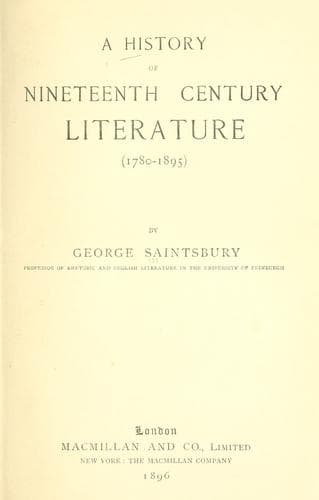
A History of Nineteenth Century Literature (1780-1895)Saintsbury, George
History
A History of Nineteenth Century Literature (1780-1895)
Saintsbury, George
English literature -- 19th century -- History and criticism
must of course be added to the poet's credit. But the Ode remains not
merely the greatest, but the one really, dazzlingly, supremely great
thing he ever did. Its theory has been scorned or impugned by some;
parts of it have even been called nonsense by critics of weight. But,
sound or unsound, sense or nonsense, it is poetry, and magnificent
poetry, from the first line to the last--poetry than which there is none
better in any language, poetry such as there is not perhaps more than a
small volume-full in all languages. The second class of merit, that of
vivid observation, abounds whereever the poems are opened. But the
examples of the first are chiefly found in the lyrics "My Heart Leaps
up," "The Sparrow's Nest"; the famous daffodil poem which Jeffrey
thought "stuff," which some say Dorothy wrote chiefly, and which is
almost perfect of its kind; the splendid opening of the "Lines to
Hartley Coleridge," which connect themselves with the "Immortality
Ode"; the exquisite group of the "Cuckoo," the best patches of the Burns
poems, and the three "Yarrows"; the "Peel Castle" stanzas; and, to cut a
tedious catalogue short, the hideously named but in parts perfectly
beautiful "Effusion on the Death of James Hogg," the last really
masterly thing that the poet did. In some of these we may care little
for the poem as a whole, nothing for the moral the poet wishes to draw.
But the poetic moments seize us, the poetic flash dazzles our eyes, and
the whole divine despair or not more divine rapture which poetry causes
comes upon us.
One division of Wordsworth's work is so remarkable that it must have
such special and separate mention as it is here possible to give it; and
that is his exercises in the sonnet, wherein to some tastes he stands
only below Shakespeare and on a level with Milton. The sonnet, after
being long out of favour, paying for its popularity between Wyatt and
Milton by neglect, had, principally it would seem on the very inadequate
example of Bowles (see _infra_), become a very favourite form with the
new Romantics. But none of them wrote it with the steady persistence,
and none except Keats with the occasional felicity, of Wordsworth. Its
thoughtfulness suited his bent, and its limits frustrated his prolixity,
though, it must be owned, he somewhat evaded this benign influence by
writing in series. And the sonnets on "The Venetian Republic," on the
"Subjugation of Switzerland," that beginning "The world is too much with
us," that in November 1806, the first "Personal Talk," the magnificent
"Westminster Bridge," and the opening at least of that on Scott's
departure from Abbotsford, are not merely among the glories of
Wordsworth, they are among the glories of English poetry.
Public-domain text, read in full here on John Shaqi.
Reviews
Reviews
No reviews yet
Be the first to share your thoughts on this work.
Elsewhere in the archive
Join the Discussion
Join the discussion
Sign in to leave a comment or review.
Sign InorCreate an account