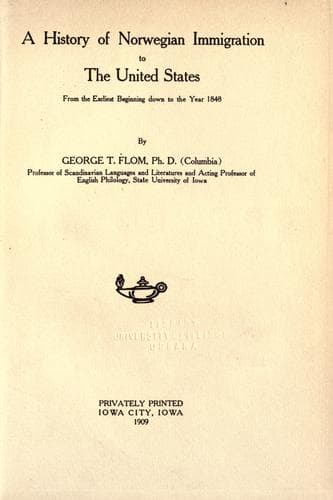
A History of Norwegian Immigration to the United States: From the Earliest Beginning down to the Year 1848 — John Shaqi
A History of Norwegian Immigration to the United States: From the Earliest Beginning down to the Year 1848Flom, George T. (George Tobias)
History
A History of Norwegian Immigration to the United States: From the Earliest Beginning down to the Year 1848
Flom, George T. (George Tobias)
Norwegians -- United States
Military service, which elsewhere has often played such an important
part in promoting emigration, has, in the Scandinavian countries, been
only a minor factor, the period of service required being very short.
Nevertheless it has in not a few cases been a secondary cause for
emigrating. Those with whom I have spoken who have given this as their
motive have, however, been mostly Norwegians and Swedes; but none of
those who belong to the earlier period of emigration give their desire
to escape military service as a cause.
Religious persecution has played a part in some cases, especially in
Norway and Sweden. The state church is the Lutheran, but every sect
has been tolerated since the middle of the century, in Norway since
1845. While few countries have been freer from the evil of active
persecution because of religious belief, intolerance and religious
narrowness have not been wanting. In the beginning of the nineteenth
century, the followers of the lay preacher, Hans Nielsen Hauge, in
Norway were everywhere persecuted. Hauge himself was imprisoned in
Christiania for eight years. And the Jansenists in Helsingland, Sweden,
were in the forties subjected to similar persecution. Thus Eric
Jansen was arrested several times for conducting religious meetings
between 1842-1846,--though it must in fairness be admitted that his
first arrest was undoubtedly provoked by the extreme procedure of the
dissenters themselves. After having been put in prison repeatedly,
Jansen embarked for America in 1846 and became the founder of the
communistic colony of followers at Bishopshille,[46] Henry County,
Illinois. No such organized emigration took place among the Haugians,
but we have no means of knowing to what extent individual emigration of
the followers of Hauge took place during the three decades immediately
after his death. The well-known Elling Eielson, a lay preacher and
an ardent Haugian, emigrated in 1839 to Fox River, La Salle County,
Illinois, and many of those who believed in the methods of Hauge and
Eielson came to America in the following years.
[46] So named from _Biskopskulla_, Jansen's native place in Sweden.
See article by Major John Swainson on "The Swedish Colony at
Bishopshill, Illinois," in Nelson's _Scandinavians_, I, p.
142. This article gives an excellent account of the founding
of the Bishopshill settlement and Jansen's connection with it.
See also _American Communities_ by Wm. Alfred Hinds, 1902, pp.
300-320.
Public-domain text, read in full here on John Shaqi.
Reviews
Reviews
No reviews yet
Be the first to share your thoughts on this work.
Join the Discussion
Join the discussion
Sign in to leave a comment or review.
Sign InorCreate an account