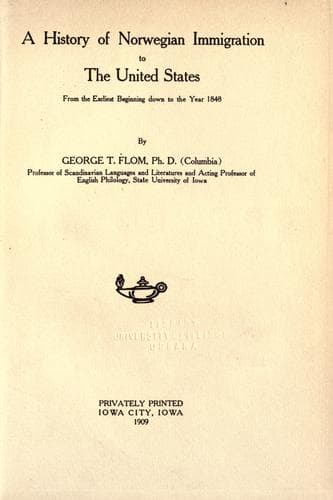
A History of Norwegian Immigration to the United States: From the Earliest Beginning down to the Year 1848Flom, George T. (George Tobias)
History
A History of Norwegian Immigration to the United States: From the Earliest Beginning down to the Year 1848
Flom, George T. (George Tobias)
Norwegians -- United States
Thus the Scandinavian farmer's son, with his love of personal
independence and his strong inherent desire to own a home, finding
himself so circumstanced in his native country that there was little
hope of his being able to realize this ambition except in the distant
uncertain future, listens, with a willing ear to descriptions of
America, with its quick returns and its great opportunities. And so
he decides to emigrate. And this he is free to do for the government
puts no barrier upon his emigrating. This trait has impelled many a
Scandinavian to come and settle in America; and it is a trait that is
the surest guarantee of the character of his citizenship. Here, too, a
social factor merits mention.
While the nobility was abolished in Norway in 1814, the lines between
the upper and lower classes, the wealthy and the poor, were tightly
drawn and social classes were well defined. And while Norway is today
the most democratic country in Europe, and Sweden and Denmark are
also thoroughly liberal (in part through the influence of America and
American-Scandinavians), a titled aristocracy still exists in these
countries. The extreme deference to those in superior station or
position that custom and existing conditions enforced upon those in
humbler condition was repugnant to them. Not infrequently have pioneers
given this as one cause for emigrating in connection with that of
economic advantage.
CHAPTER VII
_Causes of Emigration Continued. Special Factors.
Religion as a Cause. Emigration Agents._
In the class of special causes which have influenced the Scandinavian
emigration, political oppression has operated only in the case of the
Danes in Southern Jutland.[45]
[45] As a result of the Dano-Prussian war of 1864 Jutland below
Skodborghus became a province of Prussia. The greatly
increased taxes that immediately followed and the restrictions
imposed by the Prussian government upon the use of the
Danish language, as well as other oppressive measures that
formed a part of the general plan of the Prussianizing of
Sleswick-Holstein, drove large numbers of Danes away from
their homes, and most of these came to the United States. In
notes and correspondence from Denmark in Scandinavian-American
papers during these years complaints regarding such
regulations constantly appear, and figures of emigration of
Danes "who did not wish to be Prussians" are unusually large
for this period; for example in the foreign column of the
_Billed-Magazin_. The United States statistics also show a
sudden increase in the Danish immigration during the sixties
and the early seventies. From 1850-1861 not more than 3,983
had emigrated from Denmark; while in the thirteen years from
1862 to 1874 the number reached 30,978.
Public-domain text, read in full here on John Shaqi.
Reviews
Reviews
No reviews yet
Be the first to share your thoughts on this work.
Join the Discussion
Join the discussion
Sign in to leave a comment or review.
Sign InorCreate an account