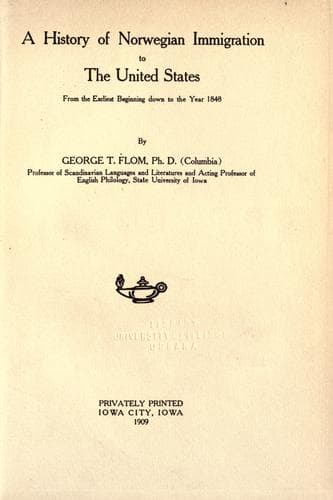
A History of Norwegian Immigration to the United States: From the Earliest Beginning down to the Year 1848Flom, George T. (George Tobias)
History
A History of Norwegian Immigration to the United States: From the Earliest Beginning down to the Year 1848
Flom, George T. (George Tobias)
Norwegians -- United States
It is perfectly clear to me that not very many of the Orleans County
colonists were devout Quakers; for we soon find them wandering apart
into various other churches. Some returned to Lutheranism; those who
went west became mostly Methodists or Mormons; others did not join
any church; while the descendants of those who remained are to-day
Methodists. The Orleans County Quakers do not seem to have even erected
a meeting-house; and in Scandinavian settlements a church, however
humble, is, next to a home, the first thought.[51] Nevertheless the
Quakers of Stavanger did suffer annoyances, and it must be remembered
that the leader of the expedition and the owner of the sloop was a
devout Quaker,[52] as were also at least two other leading members of
the party. Had it not been for these very men the party would probably
not have emigrated, at least not at that time.
[51] The reader who knows Björnson's _Synnöve Solbakken_ will
remember the author's introduction of this feature in Chapter
II, the first two pages.
[52] Lars Larson settled in Rochester where he could attend a
Quaker church. The same is true of Ole Johnson, another of the
"sloopers" who later settled in Kendall but finally returned
to Rochester, where he died in 1877.
There was much persecution of the early converts to the Baptist faith
in Denmark between 1850-1860; and not a few of this sect emigrated. In
1848 F. O. Nilson, one of the early leaders of the Baptist Church in
Sweden, was imprisoned and later banished from the country. He fled
to Denmark, and in 1851 embarked for America. In the fifties Swedish
Baptists in considerable numbers came to the United States because of
persecution. There are, however, very few Norwegian Baptists, and I
know of no cases where persecution drove Baptists to leave Norway.
Proselyting of some non-Lutheran churches in Scandinavia has been the
means of bringing many Swedes, Norwegians, and Danes to this country.
In the fifties Mormon missionaries were especially active in Denmark
and Norway. Their efforts did not seem to be attended by much success
in Norway, though not a few converts were made among the Norwegians
in the early settlements in Illinois and Iowa, as in the Fox River
Settlement.[53] In Denmark, however, Mormon proselyting was more
successful than in Norway. All those who accepted Mormonism emigrated
to America of course, and most of them to Utah. In the years 1851,
1852, and 1853 there emigrated fourteen, three, and thirty-two Danes,
respectively, to this country. But in 1854 the number rose to 691, and
in the following three years to 1,736. In 1850 there were in Utah two
Danes; in 1870 there were 4,957. The first Norwegian to go to Utah
probably was Henrik E. Sebbe, who came to America in 1836, and went to
Utah in 1848, where he became a Mormon.[53]
Public-domain text, read in full here on John Shaqi.
Reviews
Reviews
No reviews yet
Be the first to share your thoughts on this work.
Join the Discussion
Join the discussion
Sign in to leave a comment or review.
Sign InorCreate an account