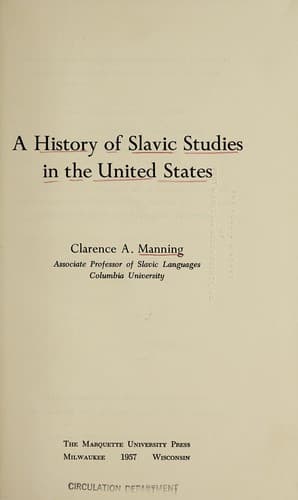
A history of Slavic studies in the United StatesManning, Clarence Augustus
History
A history of Slavic studies in the United States
Manning, Clarence Augustus
Slavic philology -- Study and teaching; Slavs -- History -- Study and teaching
The greatest single deterrent to Slavic study was the almost
simultaneous death of nearly all the older leaders of Slavic
scholarship. To list but a few of the more prominent: Professor John
Dyneley Prince, who had retired from Columbia in 1937, died in 1945 at
the age of 77; Professor Alexander Kaun, of the University of
California, died at the age of 55 in 1944; Professor George Z. Patrick,
of the same institution, died at the age of 63 in 1945; Professor Henry
Lanz, of Stanford, died in 1945 at the age of 59; Professor Samuel
Hazzard Cross, of Harvard, died in 1944 at the age of 55.[39] Thus,
within three years practically all the older men in the field of Slavic
literature died except Professor George Rapall Noyes and Professor
Manning. The losses in history were not so severe but Professor Samuel
N. Harper, of the University of Chicago, died in 1943 at the age of 61.
As a result Professor Robert J. Kerner, for many years at the University
of California, was the only person remaining in the field of history who
had become prominent before 1914. This, in a sense, sharply delineates
the earlier period of Slavic studies. Today the leaders of Slavic
scholarship belong definitely to a different generation, one which is
certainly better trained but does not necessarily have the range of
interests which often marked the older men.
Another, somewhat different, development needs to be noted. During the
first years of the War, when England was severely strained by the war
and the bombing of her cities, it seemed that the _Slavonic and East
European Review_ would be compelled to suspend publication. To meet the
crisis it was decided that the journal would continue under the
direction of the American contributing editors. Thus, until his untimely
death, Professor Cross was the practical editor of the magazine,
assisted by Professor Leonid I. Strakhovsky. Issues appeared with both
an American and British volume number. After the War when the British
expressed a desire to resume publication, the American editors expanded
their numbers and, with the aid of the Joint Committee on Slavic
Studies, established the American Association for the Advancement of
Slavic Studies to publish _The American Slavic and East European
Review_. The present committee of scholars in charge of the publication
is Professor Abram Bergson of Harvard; Professor George B. Cressey of
Syracuse; Professor H. H. Fisher of Stanford; Professor Alexander
Gerschenkron of Harvard; Professor Oskar Halecki of Fordham University;
Professor Roman Jakobson of Harvard; Professor Michael Karpovich of
Harvard; Professor Robert J. Kerner of California; Professor W. Lednicki
of California; Professor Philip Mosely of the Council for Foreign
Relations; Professor Geroid Robinson of Columbia; Professor Alfred Senn
of the University of Pennsylvania; Professor Ernest J. Simmons of
Columbia; Professor S. H. Thomson of the University of Colorado;
Professor George Vernadsky of Yale, and Professor Francis J.
Public-domain text, read in full here on John Shaqi.
Reviews
Reviews
No reviews yet
Be the first to share your thoughts on this work.
Elsewhere in the archive
Join the Discussion
Join the discussion
Sign in to leave a comment or review.
Sign InorCreate an account