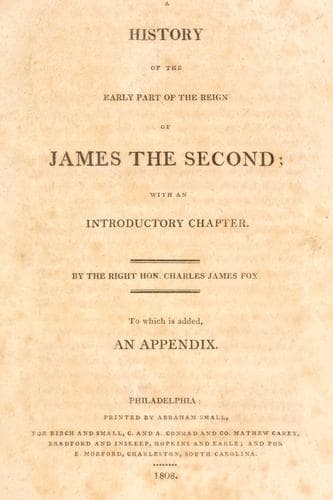
A History of the Early Part of the Reign of James the SecondFox, Charles James
History
A History of the Early Part of the Reign of James the Second
Fox, Charles James
Great Britain -- History -- James II, 1685-1688
With respect to the character of this prince, upon the delineation of
which so much pains have been employed, by the various writers who treat
of the history of his time, it must be confessed that the facts which
have been noticed in the foregoing pages furnish but too many
illustrations of the more unfavourable parts of it. From these we may
collect that his ambition was directed solely against his subjects, while
he was completely indifferent concerning the figure which he or they
might make in the general affairs of Europe; and that his desire of power
was more unmixed with love of glory than that of any other man whom
history has recorded; that he was unprincipled, ungrateful, mean, and
treacherous, to which may be added, vindictive and remorseless. For
Burnet, in refusing to him the praise of clemency and forgiveness, seems
to be perfectly justifiable, nor is it conceivable upon what pretence his
partisans have taken this ground of panegyric. I doubt whether a single
instance can be produced of his having spared the life of any one whom
motives either of policy, or of revenge, prompted him to destroy. To
allege that of Monmouth as it would be an affront to human nature, so
would it likewise imply the most severe of all satires against the
monarch himself, and we may add, too, an undeserved one; for, in order to
consider it as an act of meritorious forbearance on his part, that he did
not follow the example of Constantine and Philip II., by imbruing his
hands in the blood of his son, we must first suppose him to have been
wholly void of every natural affection, which does not appear to have
been the case. His declaration that he would have pardoned Essex, being
made when that nobleman was dead, and not followed by any act evincing
its sincerity, can surely obtain no credit from men of sense. If he had
really had the intention, he ought not to have made such a declaration,
unless he accompanied it with some mark of kindness to the relations, or
with some act of mercy to the friends of the deceased. Considering it as
a mere piece of hypocrisy, we cannot help looking upon it as one of the
most odious passages of his life. This ill-timed boast of his intended
mercy, and the brutal taunt with which he accompanied his mitigation (if
so it may be called) of Russell's sentence, show his insensibility and
hardness to have been such, that in questions where right feelings were
concerned, his good sense, and even the good taste for which he has been
so much extolled, seemed wholly to desert him.
Public-domain text, read in full here on John Shaqi.
Reviews
Reviews
No reviews yet
Be the first to share your thoughts on this work.
Join the Discussion
Join the discussion
Sign in to leave a comment or review.
Sign InorCreate an account