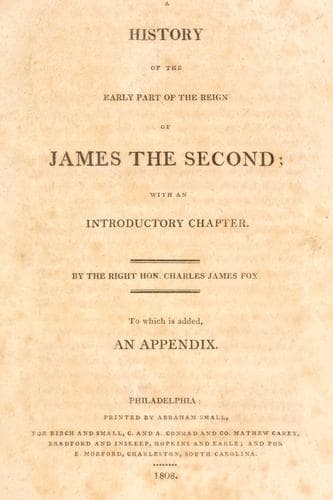
A History of the Early Part of the Reign of James the SecondFox, Charles James
History
A History of the Early Part of the Reign of James the Second
Fox, Charles James
Great Britain -- History -- James II, 1685-1688
On the other hand, it would be want of candour to maintain that Charles
was entirely destitute of good qualities; nor was the propriety of
Burnet's comparison between him and Tiberius ever felt, I imagine, by any
one but its author. He was gay and affable, and, if incapable of the
sentiments belonging to pride of a laudable sort, he was at least free
from haughtiness and insolence. The praise of politeness, which the
stoics are not perhaps wrong in classing among the moral virtues,
provided they admit it to be one of the lowest order, has never been
denied him, and he had in an eminent degree that facility of temper
which, though considered by some moralists as nearly allied to vice, yet,
inasmuch as it contributes greatly to the happiness of those around us,
is in itself not only an engaging but an estimable quality. His support
of the queen during the heats raised by the popish plot ought to be taken
rather as a proof that he was not a monster than to be ascribed to him as
a merit; but his steadiness to his brother, though it may and ought, in a
great measure, to be accounted for upon selfish principles, had at least
a strong resemblance to virtue.
The best part of this prince's character seems to have been his kindness
towards his mistresses, and his affection for his children, and others
nearly connected to him by the ties of blood. His recommendation of the
Duchess of Portsmouth and Mrs. Gwyn, upon his death-bed, to his successor
is much to his honour; and they who censure it seem, in their zeal to
show themselves strict moralists, to have suffered their notions of vice
and virtue to have fallen into strange confusion. Charles's connection
with those ladies might be vicious, but at a moment when that connection
was upon the point of being finally and irrevocably dissolved, to concern
himself about their future welfare and to recommend them to his brother
with earnest tenderness was virtue. It is not for the interest of
morality that the good and evil actions, even of bad men, should be
confounded. His affection for the Duke of Gloucester and for the Duchess
of Orleans seems to have been sincere and cordial. To attribute, as some
have done, his grief for the loss of the first to political
considerations, founded upon an intended balance of power between his two
brothers, would be an absurd refinement, whatever were his general
disposition; but when we reflect upon that carelessness which, especially
in his youth, was a conspicuous feature of his character, the absurdity
becomes still more striking. And though Burnet more covertly, and Ludlow
more openly, insinuate that his fondness for his sister was of a criminal
nature, I never could find that there was any ground whatever for such a
suspicion; nor does the little that remains of their epistolary
correspondence give it the smallest countenance. Upon the whole, Charles
II. was a bad man and a bad king; let us not palliate his crimes, but
Public-domain text, read in full here on John Shaqi.
Reviews
Reviews
No reviews yet
Be the first to share your thoughts on this work.
Join the Discussion
Join the discussion
Sign in to leave a comment or review.
Sign InorCreate an account