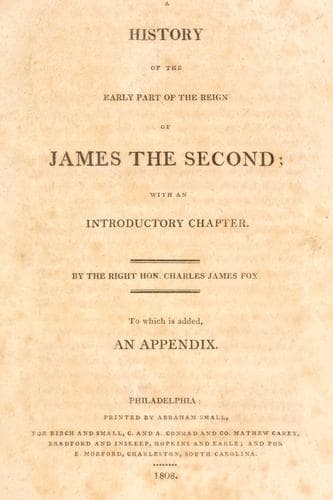
A History of the Early Part of the Reign of James the SecondFox, Charles James
History
A History of the Early Part of the Reign of James the Second
Fox, Charles James
Great Britain -- History -- James II, 1685-1688
But whatever doubts or difficulties might be felt, few or none were
expressed. The Whigs, as a vanquished party, were either silent or not
listened to, and the Tories were in a temper of mind which does not
easily admit suspicion. They were not more delighted with the victory
they had obtained over their adversaries, than with the additional
stability which, as they vainly imagined, the accession of the new
monarch was likely to give to their system. The truth is that, his
religion excepted (and that objection they were sanguine enough to
consider as done away by a few gracious words in favour of the Church),
James was every way better suited to their purpose than his brother. They
had entertained continual apprehensions, not perhaps wholly unfounded, of
the late king's returning kindness to Monmouth, the consequences of which
could not easily be calculated; whereas, every occurrence that had
happened, as well as every circumstance in James's situation, seemed to
make him utterly irreconcilable with the Whigs. Besides, after the
reproach, as well as alarm, which the notoriety of Charles's treacherous
character must so often have caused them, the very circumstance of having
at their head a prince, of whom they could with any colour hold out to
their adherents that his word was to be depended upon, was in itself a
matter of triumph and exultation. Accordingly, the watchword of the
party was everywhere--"We have the word of a king, and a word never yet
broken;" and to such a length was the spirit of adulation, or perhaps the
delusion, carried, that this royal declaration was said to be a better
security for the liberty and religion of the nation than any which the
law could devise.
The king, though much pleased, no doubt, with the popularity which seemed
to attend the commencement of his reign, as a powerful medium for
establishing the system of absolute power, did not suffer himself, by any
show of affection from his people, to be diverted from his design of
rendering his government independent of them. To this design we must
look as the mainspring of all his actions at this period; for with regard
to the Roman Catholic religion, it is by no means certain that he yet
thought of obtaining for it anything more than a complete toleration.
With this view, therefore, he could not take a more judicious resolution
than that which he had declared in his speech to the privy council, and
to which he seems, at this time, to have steadfastly adhered, of making
the government of his predecessor the model for his own. He therefore
continued in their offices, notwithstanding the personal objections he
might have to some of them, those servants of the late king, during whose
administration that prince had been so successful in subduing his
subjects, and eradicating almost from the minds of Englishmen every
sentiment of liberty.
Public-domain text, read in full here on John Shaqi.
Reviews
Reviews
No reviews yet
Be the first to share your thoughts on this work.
Join the Discussion
Join the discussion
Sign in to leave a comment or review.
Sign InorCreate an account