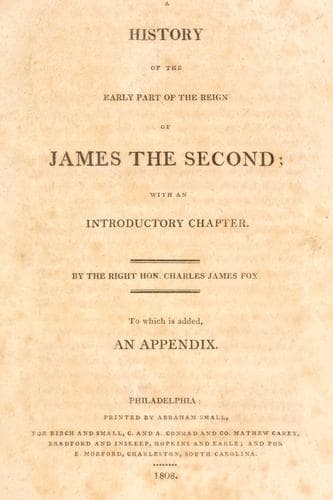
A History of the Early Part of the Reign of James the SecondFox, Charles James
History
A History of the Early Part of the Reign of James the Second
Fox, Charles James
Great Britain -- History -- James II, 1685-1688
In order to keep up that spirit in the nation, which was thought to be
manifested in the addresses, his majesty ordered the declaration, to
which allusion was made in the last chapter, to be published, interwoven
with a history of the Rye House Plot, which is said to have been drawn by
Dr. Spratt, Bishop of Rochester. The principal drift of this publication
was, to load the memory of Sidney and Russell, and to blacken the
character of the Duke of Monmouth, by wickedly confounding the
consultations holden by them with the plot for assassinating the late
king, and in this object it seems in a great measure to have succeeded.
He also caused to be published an attestation of his brother's having
died a Roman Catholic, together with two papers, drawn up by him, in
favour of that persuasion. This is generally considered to have been a
very ill-advised instance of zeal; but probably James thought, that at a
time when people seemed to be so in love with his power, he might safely
venture to indulge himself in a display of his attachment to his
religion; and perhaps, too, it might be thought good policy to show that
a prince, who had been so highly complimented as Charles had been, for
the restoration and protection of the Church, had, in truth, been a
Catholic, and thus to inculcate an opinion that the Church of England
might not only be safe, but highly favoured, under the reign of a popish
prince.
Partly from similar motives, and partly to gratify the natural
vindictiveness of his temper, he persevered in a most cruel persecution
of the Protestant dissenters, upon the most frivolous pretences. The
courts of justice, as in Charles's days, were instruments equally ready,
either for seconding the policy or for gratifying the bad passions of the
monarch; and Jeffreys, whom the late king had appointed chief justice of
England a little before Sidney's trial, was a man entirely agreeable to
the temper, and suitable to the purposes, of the present government. He
was thought not to be very learned in his profession; but what might be
wanting in knowledge he made up in positiveness; and, indeed, whatever
might be the difficulties in questions between one subject and another,
the fashionable doctrine, which prevailed at that time, of supporting the
king's prerogative in its full extent, and without restriction or
limitation, rendered, to such as espoused it, all that branch of law
which is called constitutional extremely easy and simple. He was as
submissive and mean to those above him as he was haughty and insolent to
those who were in any degree in his power; and if in his own conduct he
did not exhibit a very nice regard for morality, or even for decency, he
never failed to animadvert upon, and to punish, the most slight deviation
in others with the utmost severity, especially if they were persons whom
he suspected to be no favourites of the court.
Public-domain text, read in full here on John Shaqi.
Reviews
Reviews
No reviews yet
Be the first to share your thoughts on this work.
Elsewhere in the archive
Join the Discussion
Join the discussion
Sign in to leave a comment or review.
Sign InorCreate an account