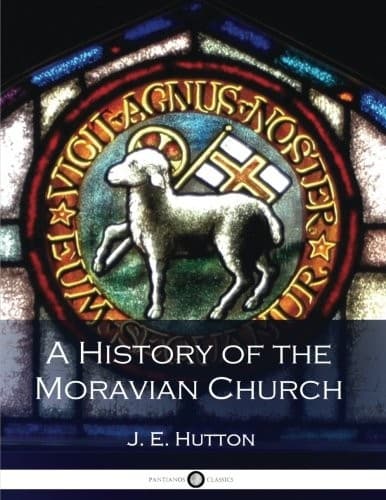
A History of the Moravian ChurchHutton, J. E. (Joseph Edmund)
Religion
A History of the Moravian Church
Hutton, J. E. (Joseph Edmund)
Moravian Church -- History
the old doctrine of justification by works was modified; and thus the
Brethren's Church became the first organized Evangelical Church in
Europe.[19]
And Luke designed to make her the strongest, too. His energy never
seemed to flag. As he wished to establish the ministry more firmly,
he had the number of Bishops enlarged, and became a Bishop himself. He
enlarged the governing Council, with his friend Procop of Neuhaus as
Ecclesiastical Judge. He beautified the Church Services, and made the
ritual more ornate. He introduced golden communion cups and delicately
embroidered corporals, and some of the Brethren actually thought that
he was leading them back to Rome. He gave an impulse to Church music,
encouraged reading both in Priests and in people, and made a use of the
printing press which in those days was astounding. Of the five printing
presses in all Bohemia, three belonged to the Brethren; of sixty printed
works that appeared between 1500 and 1510, no fewer than fifty were
published by the Brethren; and of all the scribes of the sixteenth
century, Luke was the most prolific. He wrote a "Catechism for
Children." He edited the first Brethren's hymn book (1501), the first
Church hymnal in history. He published a commentary on the Psalms,
another on the Gospel of St. John, and another on the eleventh chapter
of 1 Corinthians; he drew up "Confessions of Faith," and sent them to
the King; and thus, for the first time in the history of Bohemia, he
made the newly invented press a mighty power in the land.
And even with this the good Bishop was not content {1491.}. If the
Brethren, thought he, were true to their name, they must surely long for
fellowship with others of like mind with themselves. For this purpose
Luke and his friends set off to search for Brethren in other lands. Away
went one to find the pure Nestorian Church that was said to exist in
India, got as far as Antioch, Jerusalem and Egypt, and, being misled
somehow by a Jew, returned home with the wonderful notion that the River
Nile flowed from the Garden of Eden, but with no more knowledge of the
Church in India than when he first set out. Another explored the South
of Russia, and the third sought Christians in Turkey. And Luke himself
had little more success. He explored a number of Monasteries in Greece,
came on to Rome {1498.}, saw the streets of the city littered with
corpses of men murdered by Cæsar Borgia, picked up some useful
information about the private character of the Pope, saw Savonarola put
to death in Florence, fell in with a few Waldenses in the Savoy, and
then, having sought for pearls in vain, returned home in a state of
disgust, and convinced that, besides the Brethren, there was not to be
found a true Christian Church on the face of God's fair earth. He even
found fault with the Waldenses.
Public-domain text, read in full here on John Shaqi.
Reviews
Reviews
No reviews yet
Be the first to share your thoughts on this work.
Join the Discussion
Join the discussion
Sign in to leave a comment or review.
Sign InorCreate an account