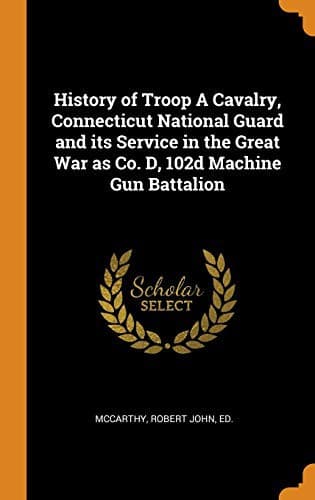
A History of Troop A Cavalry, Connecticut National Guard and Its Service in the Great War as Co. D, 102d Machine Gun Battalion
History
A History of Troop A Cavalry, Connecticut National Guard and Its Service in the Great War as Co. D, 102d Machine Gun Battalion
United States. Army. Machine Gun Battalion, 102nd. Company D; World War, 1914-1918 -- Regimental histories -- United States
Arriving in the woods northwest of Bezu le Guery late at night, the
Battalion rested for two hours and was ordered out again to return
almost to Laferte sous Jouarre, take another road in the direction
of the front, but more to the left of the position first selected,
and make camp near Montreuil aux Lions. This move was made to form a
reserve for the divisions on the line because of an expected German
attack in the vicinity of Belleau Wood. This failed to materialize and
the Battalion returned to the woods near Bezu le Guery on the night of
July 8. From there A and C Companies relieved machine gun units of
the Second Division occupying the front lines, the third platoon of D
Company going up in support of C Company on the left of the brigade
sector.
On July 10 Lieutenant Nelson and Sergeant Sullivan returned to the
Company from the machine gun school at Gondricourt.
Because the 2d Division was needed to play its part in another section,
it was removed from the support of the 26th, leaving the Yankees the
only obstruction between the armies of the Crown Prince and their
announced goal at Paris. Orders were issued and the commanders of units
on the line distributed their forces in depth, a defensive arrangement
which established the greater resistance to the enemy at a point some
two kilometers to the rear of the line of contact. This plan included
the use of several batteries of 75 millimeter guns for the purpose of
direct fire at the crests of hills behind which they were located. A
certain number of machine guns were assigned each battery to aid in its
defense. Besides these, other guns were used to cover certain strategic
points on roads and in fields, so that all guns in the Battalion had
been assigned regular positions when the scheme was completed.
Fighting in this sector had not reached the stage of trench warfare
with which the men had become so familiar during their stay in the
region northwest of Toul. Trenches were nonexistent except for small
rifle pits and a few machine gun emplacements near the line. Dugouts at
their best were nothing but rude shelters which withstood the rain with
difficulty and were safe only when the Hun was not using his artillery.
Men stationed in or near the villages had the opportunity of using the
houses for sleeping quarters, but those in the many small patches of
woodland found holes in the ground the most reliable resting places.
The hitherto despised pup tent came into use where it was permitted,
and the men made themselves comfortable as possible, adding to their
rations by the confiscation of wandering flocks of chickens, and
itinerant cows furnished milk for more than one mess.
Public-domain text, read in full here on John Shaqi.
Reviews
Reviews
No reviews yet
Be the first to share your thoughts on this work.
Join the Discussion
Join the discussion
Sign in to leave a comment or review.
Sign InorCreate an account