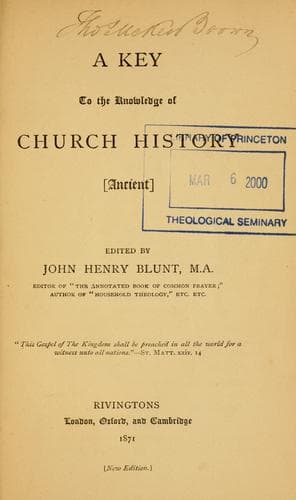
A Key to the Knowledge of Church History (Ancient) — John Shaqi
A Key to the Knowledge of Church History (Ancient)Blunt, John Henry
History
A Key to the Knowledge of Church History (Ancient)
Blunt, John Henry
Church history -- Middle Ages, 600-1500; Church history -- Primitive and early church, ca. 30-600
The false prophet Mahomet was born A.D. 569, of the chief family in the
Arabian tribe of the Koreish; but it was not till after he had amassed
a large fortune, partly by diligence in trade {89} and partly by a
wealthy marriage, that, at the age of forty, A.D. 609, he declared
himself to be a prophet. [Sidenote: and claim to be a prophet and
reformer.] This announcement was at first confined to the members of
his own immediate family, till, at the end of four years, Mahomet
proclaimed that he had a mission from God to reform the state of
religion in his native city, Mecca, and to put down the idolatry which
prevailed there. [Sidenote: Flight to Medina.] The opposition which
the false prophet encountered from his fellow-citizens did not hinder
him from making many converts to the religion he was beginning to
invent for himself and for them, until at length (A.D. 622) an
insurrection, caused by the preaching and success of Mahomet, obliged
him to fly for his life from Mecca, and take refuge at Yatreb or
Medina[1].
[Sidenote: Founds a new religion.]
Here he was gladly received both by Jews and Arabs, rival races, who
divided the city between them. The Jews were ready to welcome him as
their expected Messiah, whilst the Arabs had heard of his fame from
their brethren at Mecca; and Mahomet seems from this time to have
entirely laid aside the character of a mere reformer, for that of the
founder of a new revelation. The Koran and the Sword were now called
in to aid in their respective ways in extending the power of the
ambitious adventurer. [Sidenote: Cruelty.] Violence and bloodshed
enforced the pretended inspiration by which Mahomet claimed to be
acknowledged as _the_ Prophet of God, and the civil and religious head
of the nation; and the last ten years of his life present an almost
unbroken {90} course of warfare, which too often degenerated into
simple robbery and murder. [Sidenote: and conquests of Mahomet.] He
made himself master of the whole of Arabia, including the city of
Mecca, where he destroyed the idols against which he had in earlier
days protested, and then made an ineffectual attempt to take possession
of Palestine. [Sidenote: His death.] Mahomet died on June 8th, A.D.
632, partly from the effects of poison, which had been given to him
some years before, and partly from the consequences of a life of excess
and self-indulgence.
Section 2. _The Religion of Mahomet._
Public-domain text, read in full here on John Shaqi.
Reviews
Reviews
No reviews yet
Be the first to share your thoughts on this work.
Join the Discussion
Join the discussion
Sign in to leave a comment or review.
Sign InorCreate an account