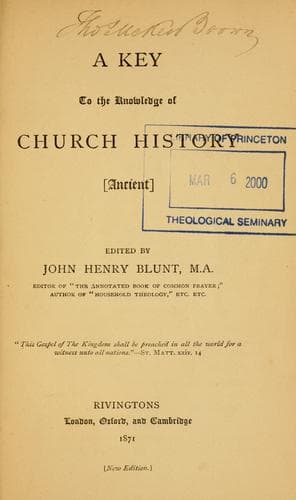
A Key to the Knowledge of Church History (Ancient)Blunt, John Henry
History
A Key to the Knowledge of Church History (Ancient)
Blunt, John Henry
Church history -- Middle Ages, 600-1500; Church history -- Primitive and early church, ca. 30-600
The false faith of which Mahomet was at once the prophet and the
founder, seems to have taken for its basis the traditionary religion
then prevalent amongst the Arab tribes. These traditions were probably
compounded of dim remnants of the Truth which had been revealed to
Abraham and handed down through his son Ishmael, and of a very corrupt
form of Sabaeanism, which included the worship of the heavenly bodies,
as well as of idols, and which had been the religion of Terah and his
fellow-countrymen. [Sidenote: Mixture of truth and error in
Mahometanism.] Upon this foundation was engrafted a mixture of Persian
philosophy, and of such perversions of Christianity and of Scriptural
doctrine as Mahomet could gather from a Persian Jew and a Nestorian
monk. [Sidenote: Opposition of the Koran to Christianity.] The Koran,
which Mahomet pretended to have received from heaven by the mouth of
the archangel Gabriel, makes mention of our Blessed Lord and of many of
the facts of Old Testament History, but its teaching is essentially
{91} anti-Christian and blasphemous, inasmuch as it denies the Divinity
of Christ, and represents Him as a Teacher and Prophet far inferior to
Mahomet himself. An intended contradiction of the Christian doctrine
of the Holy Trinity is also conveyed in its opening sentence, which is
the Mahometan confession of faith,--"There is but one God, and Mahomet
is His prophet."
[Sidenote: Mahomet's Iconoclastic tendencies.]
Mahomet's energetic opposition to idolatry was, no doubt, a good
feature in his religious system, though, like that of the
Iconoclasts[2], it was carried to an extravagant extent, and this
agreement, with their undue fears and prejudices on this head, seems to
have been a sufficient inducement to many unstable Christians to deny
the Lord, for Whose Honour they professed such deep concern, and to
give themselves up to an impostor who was perhaps the nearest approach
to Anti-Christ which the world has yet seen.
Christian people are found even in these days who do not hesitate to
speak with some degree of favour of the great apostasy of which Mahomet
was the founder, because of its opposition to idolatry, its recognition
of our Blessed Lord as a Prophet, the certain admixture of truth
contained in its grievous error, and the alleged moral teaching and
beauty of language of particular passages in the Koran. [Sidenote:
Moral effects of Mahometanism.] Any such favour or tenderness is,
however, altogether out of place in professed worshippers of Him Whom
Mahomet so grievously blasphemed, whilst the grossly sensual and
immoral lives led by the false prophet and the large proportion of his
followers down to {92} the present time, serve to show us that wrong
belief and wrong practice go hand in hand, and that whatever show of
morality there may be in some few of the precepts of the Koran, it has
no influence on the conduct of those who profess to be guided by it.
Section 3. _The Spread of Mahometanism._
Public-domain text, read in full here on John Shaqi.
Reviews
Reviews
No reviews yet
Be the first to share your thoughts on this work.
Join the Discussion
Join the discussion
Sign in to leave a comment or review.
Sign InorCreate an account