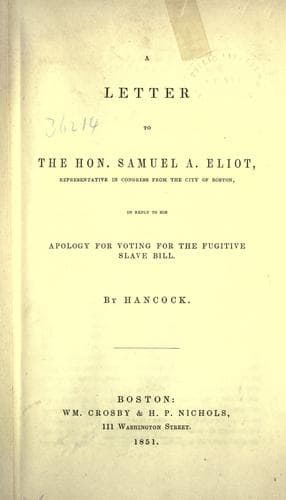
A Letter to the Hon. Samuel A. Eliot, Representative in Congress From the City of Boston, In Reply to His Apology For Voting For the Fugitive Slave Bill.Dexter, Franklin
Philosophy
A Letter to the Hon. Samuel A. Eliot, Representative in Congress From the City of Boston, In Reply to His Apology For Voting For the Fugitive Slave Bill.
Dexter, Franklin
Eliot, Samuel Atkins, 1798-1862; Fugitive slave law of 1850; Slavery -- United States
Your law, Sir, degrades the national character abroad; its excessive
servility to Southern dictation excites the contempt of the slaveholders
for the easy, selfish virtue of their Northern auxiliaries, while its
outrages upon religion, justice, humanity, and the dearest principles of
personal freedom, under pretence of preserving the Union, weaken the
attachment of conscientious men for a confederacy which requires such
horrible sacrifices for its continuance. All these evils might have been
easily avoided by a law satisfying every requirement of the
Constitution, and yet treating the alleged fugitive as a MAN, and
granting him the same protection as is accorded to an alleged murderer.
God gave you, Sir, an opportunity for which you ought to have been
grateful, of illustrating your Puritan descent by standing forth before
the nation as an advocate of justice and freedom, and of the rights of
the poor and oppressed. Through a blind devotion to a political leader,
you rejected the palm which Providence tendered to your acceptance, and
have indelibly associated your name with cruelty and injustice. Had you
retired from the notice of the public, as you did from the suffrages of
the electors, you had acted wisely. In an evil hour for yourself, you
stood forth as the champion of the Fugitive Slave Law. Its enemies
rejoice in your rashness, for your feeble apology has rendered its
deformities more prominent, and, by failing to vindicate, you have
virtually confessed its abominations. May you live, Sir, to deplore the
grievous error you have committed, and, by your future efforts in behalf
of human freedom and happiness, atone for the wound they have received
at your hands.
HANCOCK.
February, 1851.
Public-domain text, read in full here on John Shaqi.
Reviews
Reviews
No reviews yet
Be the first to share your thoughts on this work.
Elsewhere in the archive
Join the Discussion
Join the discussion
Sign in to leave a comment or review.
Sign InorCreate an account