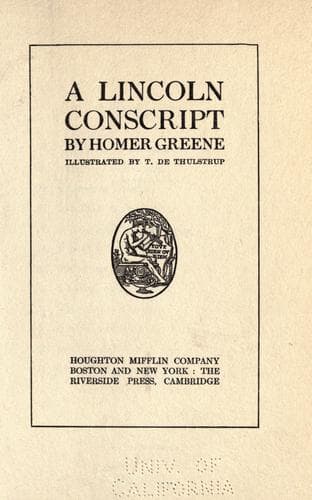
Lincoln, Abraham, 1809-1865 -- Juvenile fiction; United States -- History -- Civil War, 1861-1865 -- Juvenile fiction
The hope that he had dared to entertain on leaving home, that he
might be permitted to take his son’s place in the ranks, had now
quite vanished. Before him lay only disgrace and death and a stain
on his family name in the North for generations. It was the darkest,
most desolate hour his life had known. A small squad of soldiers, in
command of an officer, approached him, marching up the street through
the crisp morning air in brisk time, swinging their arms in unison as
they came, and the thought entered his mind that the best thing he
could do would be to surrender himself to them. But when he met them he
passed without speaking, and they paid no attention to him. A little
farther on a crippled veteran with crutches sat on the curb and asked
alms as Bannister passed by. And this hater of the Federal blue thrust
his hand into his pocket, drew forth a liberal sum, and gave it to the
uniformed beggar, without a word. The man was probably a fraud, but
what did it matter? It was doubtless a doomed man’s last opportunity to
do a charitable deed. So he passed on, up around the Treasury building
and along the front of the White House. It was almost daylight now, but
the street-lamps had not yet been extinguished, and in the President’s
mansion two windows were still brilliantly illuminated.
As Bannister reached the corner by the War Department building he
turned and looked back at the White House. There lived the man whom he
had ridiculed as a buffoon, whom he had denounced as a tyrant, whom he
had decried as a malefactor. And the remark made by Captain Yohe the
day before at Easton came back into his mind: “No power on earth can
save you from the extreme penalty meted out to deserters unless it be
Abraham Lincoln himself.”
So this man held also in his hands dominion over life and death. At
his word, spoken or withheld, he, Rhett Bannister, would live or die.
At his word, spoken or withheld, soldiers by the thousands had given
and would still give their lives that his counsels and his judgments
might prevail. What an awful responsibility! How it must weigh on a
man’s soul! How it must sober him and search him, and drive from his
heart all forms of avarice and selfishness and hatred and hypocrisy!
How could this man Lincoln, by any human possibility, be anything but
honest and humble and God-fearing, with such an awful load upon his
mind and heart!
Involuntarily, as he pondered, Bannister had turned into the park lying
between the White House and the War Department and was sauntering
leisurely up the path. There was no purpose in it. Doubtless, his
thoughts being upon Abraham Lincoln, he was drawn unconsciously toward
the physical abiding-place of the man.
Public-domain text, read in full here on John Shaqi.
Reviews
Reviews
No reviews yet
Be the first to share your thoughts on this work.
Elsewhere in the archive
Join the Discussion
Join the discussion
Sign in to leave a comment or review.
Sign InorCreate an account