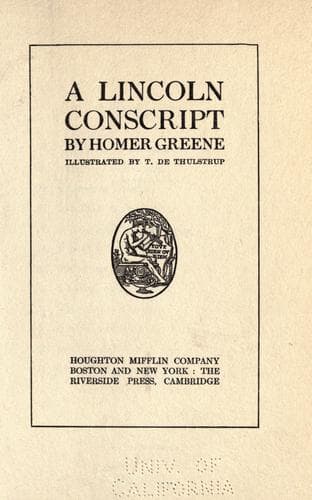
Lincoln, Abraham, 1809-1865 -- Juvenile fiction; United States -- History -- Civil War, 1861-1865 -- Juvenile fiction
“I can speak for myself only, Mr. President. I am of Southern birth
and breeding. My sympathies lie entirely with the South. I feel that
they were right on every issue between them and the abolitionists
and radicals of the North. I feel that they had just cause to secede
from the compact formed by the states, and to set up a government of
their own which should be in accord with their views and policies.
I feel that the attempt to coerce them was unjust and tyrannical. I
feel that the war, on the part of the North, has been and is an awful
mistake, criminal in many of its aspects. Feeling that way, I have done
all that lay in my power, from my home in the North, openly, and I
believe honorably, to oppose the war, and to weaken the power of your
administration. I speak frankly because you have asked me for my views.”
“That’s right; that’s right. That’s what I want to know. We must be
honest with each other. Now, don’t you think the Union, as it was, was
a splendid aggregation of states?”
“Yes, Mr. Lincoln, I do.”
“And don’t you think the Union, restored as it was, would be a still
more splendid aggregation of states?”
“I do, if the causes of war were removed.”
“Exactly! We are trying to remove them. You and your friends of the
South are trying to retain them. If their armies prevail in this
struggle, the situation is hopeless. Nothing is settled. The Union is
shattered. The future is black with trouble. If our armies prevail in
this struggle, all the issues that led to the war become dead issues.
The Union will be restored as it was. The future will be large with
promise. I can see, so far as my vision reaches, but one end that will
bring permanent peace and happiness. We must conquer the armies of the
South; we _must_ do it. The life of the Union, for which our fathers
fought, depends on it. There, I’ve said a good deal. I don’t know that
I’ve made myself clear. I don’t get a chance to talk to you copperheads
very often. I take it when I can get it.”
There was nothing flippant or sarcastic in his tone or manner. He was
frank and plain, but in deadly earnest. It required no brilliancy of
comprehension to discover that. Rhett Bannister saw it and acknowledged
it. He saw more. He saw that this man grasped the situation as no man
had ever grasped it before. That in his heart the Union was the one
thing of prime importance, and that his mind and soul and body were
tense with the desire and effort to save the Union. But was he right?
Was he right? For, while Bannister could not now but acknowledge the
sincerity and skill of the man who was talking to him, he was not yet
ready to yield his own judgment.
Public-domain text, read in full here on John Shaqi.
Reviews
Reviews
No reviews yet
Be the first to share your thoughts on this work.
Elsewhere in the archive
Join the Discussion
Join the discussion
Sign in to leave a comment or review.
Sign InorCreate an account