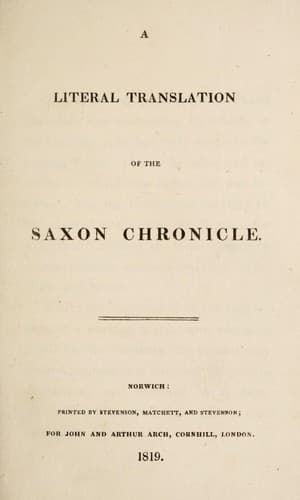
Great Britain -- History -- Anglo-Saxon period, 449-1066 -- Sources
This year King Athelstan the Lord of Earls, the Giver of Bracelets
to the Nobles, and his brother Edmund the Atheling, the elder, the
survivors of their race, the children of Edward, won lasting glory
with the edge of the sword in battle at Brunanburh.[AN] They clave
the wooden walls, they hewed down the tall banners, for it was the
portion of their lineage, that oft in the field they should defend
their lands, their treasures, their homes, against the enemy. The Scot
and the Ship-man fell on every side--the din of arms resounded sith
the sun in the morning tide rose glad over the earth, greatest of the
stars, bright candle of God the Lord Eternal, till the noblest of
things created sank in the west. There, struck down with darts, lay
many a warrior, Northmen pierced over their shields--Scots the savages
of war--The West Saxons, a chosen band, pressed the live-long day upon
the hated people. Sternly they smote down the flying multitudes, with
swords well sharpened at the stone. The Mercians shrank not from the
hard play of hands. Safety there was none for the companions of Anlaf,
for those who sought the land for deadly fight over the billowy sea,
bosomed in ships.--Five young Kings lay on the battle field, put to
sleep by the swords. So also seven Earls of Anlaf, and of the host from
the fleet, and of the Scots, more than can be numbered. The King of the
Northmen with his little troop fled in his terror to the voice of the
ship; the King of the Fleet, with one ship’s crew, living escaped over
the yellow deep.
So also the routed Constantine returned a fugitive to his northern
hills. The hoary warrior needed not to exult in the conflict of
swords.--He was the remnant of his race. His kinsmen were heaped on
the field--slain in the battle. He left his son on the place of blood,
covered with wounds. Young in war though old in wisdom, the fair-haired
youth was staid in his glorying by the bill of slaughter.
Neither could Anlaf and his broken army boast that they were better in
works of battle; at the fall of banners, at the meeting of darts, in
the conflict of men, in the exchange of weapons, when they had played
with the children of Edward in the field of death.
The Northmen, the sorrowful few spared by the darts, departed in their
nailed ships over the roaring sea--over the deep waters. They sailed
for Dublin, and disgraced their land.
Public-domain text, read in full here on John Shaqi.
Reviews
Reviews
No reviews yet
Be the first to share your thoughts on this work.
Elsewhere in the archive
Join the Discussion
Join the discussion
Sign in to leave a comment or review.
Sign InorCreate an account