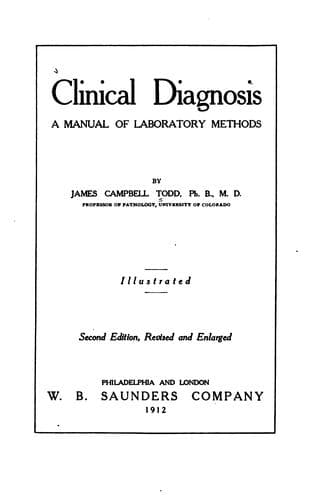
A Manual of Clinical DiagnosisTodd, James Campbell
Science
A Manual of Clinical Diagnosis
Todd, James Campbell
Diagnosis, Laboratory
Mix forty parts of (1) and one part of (2). In a test-tube take equal
parts of this mixture and the urine, and pour 1 or 2 c.c. of the
ammonia upon its surface. If the reaction be positive, a garnet ring
will form at the junction of the two fluids; and upon shaking, a
distinct pink color will be imparted to the foam. The color of the
foam is the essential feature. If desired, the mixture may be well
shaken before the ammonia is added: the pink color will then instantly
appear in that portion of the foam which the ammonia has reached, and
can be readily seen. The color varies from eosin-pink to deep crimson,
depending upon the intensity of the reaction. A doubtful reaction
should be considered negative.
* * * * *
7. Pancreatic Reaction.--Cammidge has shown that in cases of
pancreatitis a substance capable of forming {92} crystals with
phenylhydrazin can be developed by boiling the urine with a mineral
acid, and has offered the following test as an aid in diagnosis of
this obscure condition. The nature both of this substance and the
antecedent substance from which it is derived is not known. As
originally proposed, the test was complicated and probably not
trustworthy, but with his improved and simplified technic, Cammidge
has had very promising results. In 200 consecutive examinations in
which the diagnosis was confirmed, _postmortem_ or at operation, 67
cases of pancreatitis (65 chronic, 2 acute) gave positive reactions; 4
cases of cancer of the pancreas were positive, 12 negative; 4 cases in
which no pancreatitis was found were positive, 113 were negative.
Normal urines do not give the reaction. The difficulty and importance
of diagnosis in pancreatitis warrant inclusion of the method here even
though its true value cannot be definitely assigned. While the test is
somewhat tedious, all the manipulations are simple and require no
apparatus but flasks, test-tubes, and funnels.
* * * * *
Technic.--Careful attention to detail is imperative. An ordinary
routine examination is first made. Albumin and sugar, if present, must
be removed: the former, by acidifying with acetic acid, boiling, and
filtering; the latter, by fermentation with yeast after the first step
of the method proper. An alkaline urine should be made slightly acid
with hydrochloric acid.
Public-domain text, read in full here on John Shaqi.
Reviews
Reviews
No reviews yet
Be the first to share your thoughts on this work.
Join the Discussion
Join the discussion
Sign in to leave a comment or review.
Sign InorCreate an account