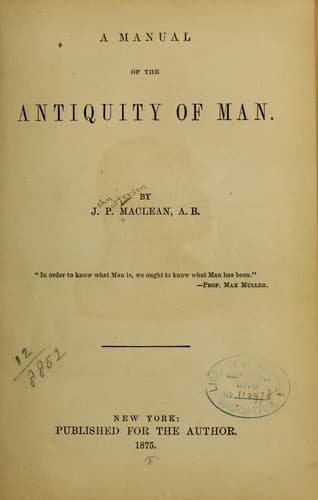
A Manual of the Antiquity of ManMacLean, J. P. (John Patterson)
History
A Manual of the Antiquity of Man
MacLean, J. P. (John Patterson)
Human beings -- Origin
The cave of Chaleux was buried by a mass of rubbish caused by the
falling in of the roof, consequently preserving all its implements.
There were found the split bones of mammals and the bones of birds and
fishes. There was an immense number of objects, chiefly manufactured
from reindeer horn, such as needles, arrow-heads, daggers, and hooks.
Besides these, there were ornaments made of shells, pieces of slate with
engraved figure, mathematical lines, remains of very coarse pottery,
hearth-stones, ashes, charcoal, and last but not least, thirty thousand
worked flints mingled with the broken bones. In the hearth, placed in
the centre of the cave, was discovered a stone, with certain but
unintelligible signs engraved upon it. M. Dupont also found about twenty
pounds of the bones of the water-rat, either scorched or roasted.
In a cave at Furfooz, Dupont found an urn, or specimen of rough pottery
(Fig. 15) intermingled with human bones. It was partly broken; by the
care of M. Hauzeur it has been put together again.
France and Belgium are not alone in their monuments of the reindeer
epoch, for settlements of this epoch have been discovered in Germany,
Switzerland, and Poland.
In the cave of Thayngen, near Schaffhausen, Switzerland, have been
discovered a few remains of the mammoth, rhinoceros, and cave-lion; the
remains of two hundred and fifty reindeer, four hundred and thirty
Alpine hares; also the remains of the brown bear, stag, elk, auroch,
glutton, wolf, and several kinds of fox. The large bones invariably
appeared in fragments, and the pebbles used for breaking them were found
in the refuse. Among birds, the bones of the swan, grouse, and duck
predominate. The implements consisted chiefly of needles, piercers, and
arrow-heads made of the antlers of the reindeer. The art of engraving
and carving was carried to quite a degree of perfection. The most
notable of these objects is the delineation of a reindeer in the act of
browsing, drawn on a piece of the horn of that animal.
Not far from Cracow (Poland), a cavern has been recently discovered and
examined by Count Zawisza. In the upper part of the floor (four feet in
depth), consisting of vegetable earth, mould, and _débris_, occurred
ashes, flint implements, and the split bones of the cave-bear, reindeer,
horse, elk, and other animals. Beneath this layer appeared the broken
bones of the mammoth, an ornament of ivory, and the perforated teeth of
the cave-bear, stag, elk, wolf, and fox. Two thousand flint implements
were obtained; and from the frequent occurrence of flint the cave was
used by the troglodytes, or cave-men, as a dwelling; and by the remains
of the fauna, it must have been occupied during the inter-glacial, and
at the beginning of the reindeer epoch.
CHAPTER IX.
MAN OF THE REINDEER EPOCH.
Public-domain text, read in full here on John Shaqi.
Reviews
Reviews
No reviews yet
Be the first to share your thoughts on this work.
Join the Discussion
Join the discussion
Sign in to leave a comment or review.
Sign InorCreate an account