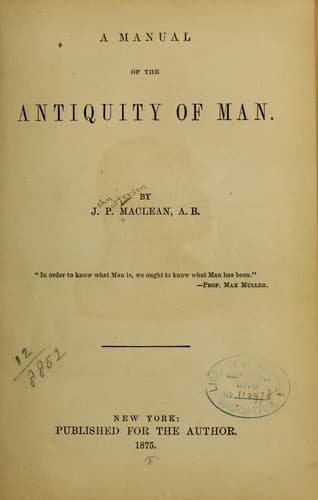
A Manual of the Antiquity of ManMacLean, J. P. (John Patterson)
History
A Manual of the Antiquity of Man
MacLean, J. P. (John Patterson)
Human beings -- Origin
_Food._--These people were essentially hunters, and lived principally
upon the reindeer, which they attacked with their spears and arrows. The
horse, elk, ox, ibex, and the chamois, formed a considerable part of
their food. The meat was cooked on the rough hearths, and the skull and
the long bones were split open in order to extract the brains and
marrow, which formed a delicious dish. To this they also added fish and,
occasionally, certain birds, such as the heath-cock, swan, and owl. The
chase did not always afford them sufficient food, and at times they were
forced to subsist on the water-rat.
Enough evidence has been produced to show that these people were
cannibals. Human finger-joints were discovered among the remains of
cooking at Solutré in Mâconnais. M. Issel found, at a point on the road
from Genoa to Nice, some human bones which had been calcined, and were
of a whitish color, light, and friable. The incrustations on their
surface still contained small fragments of carbon, and some of them
showed notches made by some sharp instrument. In one of the grottos of
Northern Italy M. Costa de Beauregard found the small shin-bone of a
child, which had been carefully emptied and cleansed. Professor Owen
thinks he can recognize the trace of human teeth on some human skulls
and children's bones found in Scotland, and promiscuously mixed with
sculptured flints and the remains of pottery.
_The Arts._--Man had not yet discovered the value of metal, but formed
his instruments out of flint, bone, and the horn of the reindeer. The
hatchet was but little used, and the principal weapons were the
flint-knife, arrow-heads, and occasionally the lower jaw-bone of the
cave-bear, with its pointed canine tooth. The articles of domestic use
were rough pottery, knives, scrapers, saws, bodkins, needles, and other
wrought implements. He had articles for ornamenting his person and
pleasing his fancy, such as shells for beads, and the whistle for
delighting his ear. The art of engraving was practised to a great
extent, and so admirably did he execute his designs that, after the
lapse of thousands of years, the figures are easily recognized.
The staff of authority would imply that there were certain individuals
who were recognized as chiefs or leaders. Some system must have
prevailed, for without it the manufactories at Laugerie-Basse and
Laugerie-Haute could not have been carried on. In the first of these
workshops the fabrications were almost wholly spear-heads, and in the
second reindeer horn was used for the weapons and implements.
_Traffic._--Commerce was begun. The inhabitants of Belgium sought their
flints in that part of France now called Champagne. From the same
locality they also brought back fossil shells, which were strung
together and used for necklaces. There can be no doubt of this, as
already fifty-four of these shells have been found at Chaleux, and they
are not found naturally anywhere else than in Champagne.
Public-domain text, read in full here on John Shaqi.
Reviews
Reviews
No reviews yet
Be the first to share your thoughts on this work.
Elsewhere in the archive
Join the Discussion
Join the discussion
Sign in to leave a comment or review.
Sign InorCreate an account