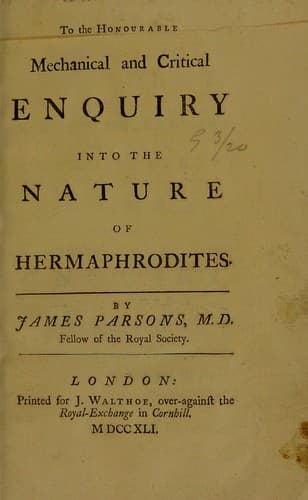
A mechanical and critical enquiry into the nature of hermaphroditesParsons, James
History
A mechanical and critical enquiry into the nature of hermaphrodites
Parsons, James
Intersexuality -- Early works to 1800
This Author asserts, that the[112] Semen is brought partly from the
Testes and Tubes by the Ligamenta Rotunda (which he calls Vessels,
and adds, that heretofore they were improperly called Ligaments) and
so emitted by the Glans; but how a Communication is carried on between
these Ligaments and the Clitoris he has not given us the least Account;
yet he persists very strenuously in that Opinion, tho’ he owns at the
same Time, that upon the Dissection of these Parts no convenient Passage
appears for such an Emission, and this turns him upon another Method of
accounting for it, which is, that the Pores of the Glans are so distended
by Heat, Agitation, _&c._ that Semen may easily pass forth. He backs this
Opinion with a Story he tells, of a Patient that complained to him of
an involuntary Emission from that Part, occasioned by her too frequent
provoking it before; part of the Words of this History may not be amiss,
in this Place, for the Reader’s Satisfaction[113].
‘Lately a Woman of no little Credit complained to me, that in her younger
Days, having early Desires, she often rubbed that Part (the Clitoris)
with her Finger, so as to provoke the Emission of Semen with much
Delight, and that in some time this ill Custom caused it to become a
Disease.’
Here he makes a Passage through the Ligamenta Rotunda for Semen to come
to the Clitoris, in order to make a close Analogy between the Penis and
that Part; and, finding no Urethra, makes it pass out by the Pores of the
Glans, and by way of Confirmation of his Opinion, tells the above Story
from the Mouth of the Woman herself, believes her, and would have the
World give Credit to it also.
In another Place[114] he absolutely confesses, no Passage like an Urethra
has hitherto been found upon Dissections in that Part; yet Reason (says
he) tells me there must be one, though in dead Bodies it disappears;
otherwise I demand by what Passage can such a Discharge proceed from
these Confricatrices and Hermaphrodites. His Words are, ‘Mulieres
Confricatrices atque etiam Hermaphroditi.’ As if these two Characters
signified different Things, which in other Authors are esteemed the same.
This is rivetting his Opinion of an Urethra, though none can be found,
and totally omitting to make any more Use of his Argument of the Pores,
whether wilfully, as believing it a weak one, or through Forgetfulness,
we cannot say; but his subsequent Histories will shew, how he tumbles
from this Notion into a direct Contradiction of a pervious Clitoris;
and as to his Pretence of the Ligamenta Rotunda’s being Vessels, every
Anatomist is able to make a Judgment; and also of what Use it is to have
a Discharge from the Clitoris, those in any wise acquainted with the
Nature of Generation, and the Structure of the Parts, will easily refute.
Now we shall proceed to take notice of some of the Histories he gives
concerning enlarged Clitorides in Women, which he takes from several
Authors, and introduces in these Words[115]:
Public-domain text, read in full here on John Shaqi.
Reviews
Reviews
No reviews yet
Be the first to share your thoughts on this work.
Join the Discussion
Join the discussion
Sign in to leave a comment or review.
Sign InorCreate an account