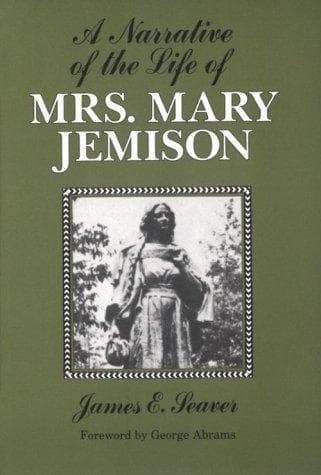
A Narrative of the Life of Mrs. Mary JemisonSeaver, James E. (James Everett)
History
A Narrative of the Life of Mrs. Mary Jemison
Seaver, James E. (James Everett)
Jemison, Mary, 1743-1833; Seneca Indians
Hiokatoo, was born in one of the tribes of the Six Nations that
inhabited the banks of the Susquehannah; or, rather he belonged to a
tribe of the Senecas that made, at the time of the great Indian treaty,
a part of those nations. He was own cousin to Farmer's Brother, a
Chief who has been justly celebrated for his worth. Their mothers were
sisters, and it was through the influence of Farmer's Brother, that I
became Hiokatoo's wife.
In early life, Hiokatoo showed signs of thirst for blood, by attending
only to the art of war, in the use of the tomahawk and scalping knife;
and in practising cruelties upon every thing that chanced to fall into
his hands, which was susceptible of pain. In that way he learned to
use his implements of war effectually, and at the same time blunted all
those fine feelings and tender sympathies that are naturally excited, by
hearing or seeing, a fellow being in distress. He could inflict the
most excruciating tortures upon his enemies, and prided himself upon
his fortitude, in having performed the most barbarous ceremonies and
tortures, without the least degree of pity or remorse. Thus qualified,
when very young he was initiated into scenes of carnage, by being
engaged in the wars that prevailed amongst the Indian tribes.
In the year 1731, he was appointed a runner, to assist in collecting an
army to go against the Cotawpes, Cherokees and other southern Indians. A
large army was collected, and after a long and fatiguing march, met its
enemies in what was then called the "low, dark and bloody lands," near
the mouth of Red River, in what is now called the state of Kentucky.
[Footnote: Those powerful armies met near the place that is now called
Clarksville, which is situated at the fork where Red River joins the
Cumberland, a few miles above the line between Kentucky and Tennessee.]
The Cotawpes [Footnote: The Author acknowledges himself unacquainted,
from Indian history, with a nation of this name; but as 90 years have
elapsed since the date of this occurrence, it is highly probable that
such a nation did exist, and that it was absolutely exterminated at
that eventful period.] and their associates, had, by some means, been
apprized of their approach, and lay in ambush to take them at once, when
they should come within their reach, and destroy the whole army. The
northern Indians, with their usual sagacity, discovered the situation of
their enemies, rushed upon the ambuscade and massacred 1200 on the
spot. The battle continued for two days and two nights, with the utmost
severity, in which the northern Indians were victorious, and so far
succeeded in destroying the Cotawpes that they at that time ceased to be
a nation. The victors suffered an immense loss in killed; but gained the
hunting ground, which was their grand object, though the Cherokees would
not give it up in a treaty, or consent to make peace. Bows and arrows,
at that time were in general use, though a few guns were employed.
Public-domain text, read in full here on John Shaqi.
Reviews
Reviews
No reviews yet
Be the first to share your thoughts on this work.
Elsewhere in the archive
Join the Discussion
Join the discussion
Sign in to leave a comment or review.
Sign InorCreate an account