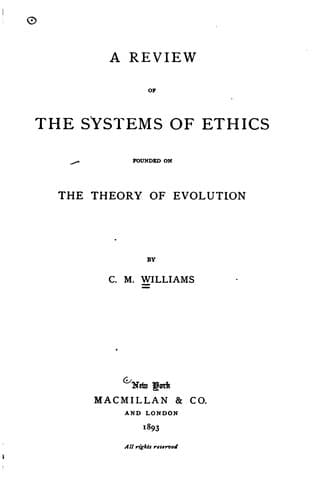
A Review of the Systems of Ethics Founded on the Theory of EvolutionWilliams, Cora May
Philosophy
A Review of the Systems of Ethics Founded on the Theory of Evolution
Williams, Cora May
Ethics, Evolutionary
"To make my position fully understood, it seems needful to add that,
corresponding to the fundamental propositions of a developed Moral
Science, there have been, and still are, developing in the race, certain
fundamental moral intuitions; and that, though these moral intuitions
are the results of accumulated experiences of Utility, gradually
organized and inherited, they have come to be quite independent of
conscious experience. Just in the same way that I believe the intuition
of space possessed by any living individual, to have arisen from the
organized and consolidated experiences of all antecedent individuals,
who bequeathed to him their slowly developed nervous organizations--just
as I believe that this intuition, requiring only to be made definite and
complete by personal experiences, has practically become a form of
thought, apparently quite independent of experience; so do I believe
that the experiences of utility organized and consolidated through all
past generations of the human race, have been producing nervous
modifications, which, by continued transmission and accumulation, have
become in us certain faculties of moral intuition, certain emotions
responding to right and wrong conduct, which have no apparent basis in
the individual experiences of utility. I also hold that, just as the
space-intuition responds to the exact demonstrations of geometry, and
has its rough conclusions interpreted and verified by them, so will
moral intuitions respond to the demonstrations of Moral Science; and
will have their rough conclusions interpreted and verified by them."
In "Recent Discussions in Science, Philosophy, and Morals"[39] (1871),
Spencer, after quoting portions of the above letter as defining his
position, continues with a consideration of the continual readjustment
of the compromise between the ideal and the practicable, the former of
which prescribes a system far too good for men as they are, the latter
of which does not of itself tend to establish a system better than the
existing one; and he reiterates his law of the perfect man as follows:--
"Granted that we are chiefly interested in ascertaining what is
_relatively_ right, it still follows that we must first consider what is
absolutely right; since the one conception presupposes the other."
Spencer further expressly repudiates empirical Utilitarianism, and
denies the assertion of Mr. Hutton that he by implication recognizes no
parentage for morals beyond that of the accumulation and organization of
the facts of experience. On this head he says:--
Public-domain text, read in full here on John Shaqi.
Reviews
Reviews
No reviews yet
Be the first to share your thoughts on this work.
Join the Discussion
Join the discussion
Sign in to leave a comment or review.
Sign InorCreate an account