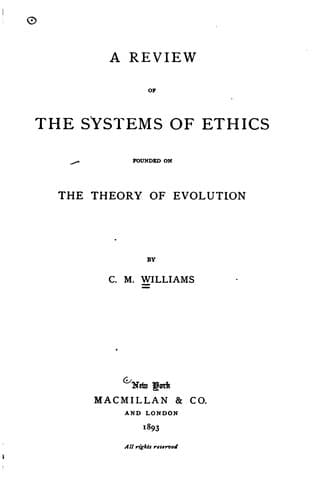
A Review of the Systems of Ethics Founded on the Theory of EvolutionWilliams, Cora May
Philosophy
A Review of the Systems of Ethics Founded on the Theory of Evolution
Williams, Cora May
Ethics, Evolutionary
"In the genesis of an idea, the successive experiences, be they of
sounds, colors, touches, tastes, or be they of the special objects that
combine many of these into groups, have so much in common that each,
when it occurs, can be definitely thought of as like those which
preceded it. But in the genesis of an emotion, the successive
experiences so far differ that each of them, when it occurs, suggests
past experiences which are not specifically similar, but have only a
general similarity; and, at the same time, it suggests benefits or evils
in past experience which likewise are various in their special natures,
though they have a certain community of general nature. Hence it results
that the consciousness aroused is a multitudinous confused
consciousness, in which, along with a certain kind of combination among
impressions received from without, there is a vague cloud of ideal
combinations akin to them, and a vague mass of ideal feelings of
pleasure or pain that were associated with them. We have abundant proof
that feelings grow up without reference to recognized causes and
consequences, and without the possessor of them being able to say why
they have grown up, though analysis, nevertheless, shows that they have
been formed out of connected experiences. The experiences of utility I
refer to are those which become registered, not as distinctly recognized
connections between certain kinds of acts and certain kinds of remote
results, but those which become registered in the shape of associations
between groups of feelings that have often recurred together,
though the relation between them has not been consciously
generalized"--associations which though little perceived, nevertheless
serve as incentives or deterrents. Much deeper down than the history of
the human race must we go to find the beginnings of these connections.
The appearances and sounds which excite in the infant a vague dread
indicate danger; and do so because they are the physiological
accompaniments of destructive action.
"What we call the natural language of anger is due to a partial
contraction of those muscles which actual combat would call into play;
and all marks of irritation, down to that passing shade over the brow
which accompanies slight annoyance, are incipient stages of these same
contractions. Conversely with the natural language of pleasure, and of
that state of mind which we call amicable feeling; this, too, has a
physical interpretation."
Public-domain text, read in full here on John Shaqi.
Reviews
Reviews
No reviews yet
Be the first to share your thoughts on this work.
Join the Discussion
Join the discussion
Sign in to leave a comment or review.
Sign InorCreate an account