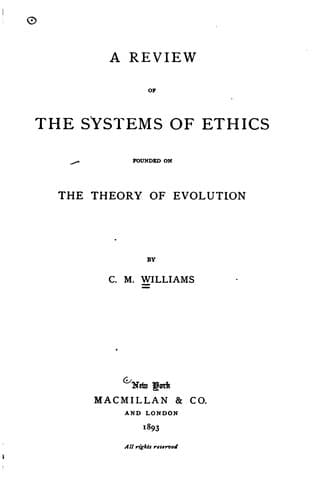
A Review of the Systems of Ethics Founded on the Theory of EvolutionWilliams, Cora May
Philosophy
A Review of the Systems of Ethics Founded on the Theory of Evolution
Williams, Cora May
Ethics, Evolutionary
"The mental process by which, in any case, the adjustment of acts to
ends is effected and which, under its higher forms, becomes the
subject-matter of ethical judgments, is, as above implied, divisible
into the rise of a feeling or feelings constituting the motive, and the
thought or thoughts through which the motive is shaped and finally
issues in action. The first of these elements, originally an excitement,
becomes a simple sensation; then a compound sensation; then a cluster of
partially presentative and partially representative sensations, forming
an incipient emotion; then a cluster of exclusively ideal or
representative sensations forming an emotion proper; then a cluster of
such clusters forming a compound emotion; and eventually becomes a still
more involved emotion composed of the ideal forms of such compound
emotions. The other element, beginning with that immediate passage of a
single stimulus into a single motion, called reflex action, presently
comes to be a set of associated discharges of stimuli producing
associated motions; constituting instinct. Step by step arise more
entangled combinations of stimuli, somewhat variable in their modes of
union, leading to complex motions, similarly variable in their
adjustments; whence occasional hesitations in the sensori-motor
processes. Presently is reached a stage at which the combined clusters
of impressions, not all present together, issue in actions not all
simultaneous, implying representation of results, or thought. Afterwards
follow stages in which various thoughts have time to pass before the
composite motives produce the appropriate actions, until at last arise
those long deliberations during which the probabilities of various
consequences are estimated, and the promptings of the correlative
feelings balanced; constituting calm judgment. That, under either of its
aspects, the later forms of this mental process are the higher,
ethically considered as well as otherwise considered, will be readily
seen."[43]
Public-domain text, read in full here on John Shaqi.
Reviews
Reviews
No reviews yet
Be the first to share your thoughts on this work.
Elsewhere in the archive
Join the Discussion
Join the discussion
Sign in to leave a comment or review.
Sign InorCreate an account