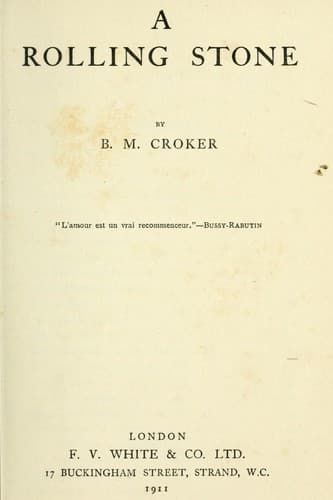
England -- Social life and customs -- 20th century -- Fiction; Household employees -- Fiction; Young men -- Fiction
The morning succeeding the motor’s first trip proved depressingly wet;
thick mists of cold spring rain shrouded the outlook from the Manor,
beat down upon the pleasure ground, and made pools in the hollows of
the drive.
Miss Parrett, who was, as the servants expressed it, “dodging” in and
out of the sitting-room, issuing commands and then withdrawing them,
fastened upon the chauffeur the moment he came for orders.
No, the car would not be required, and he could go some errands into
the village.
“Mind you don’t go loitering and gossiping,” she added. “I know your
sort, chattering with the maids. Remember that your time belongs to
me;” and she pointed a stumpy forefinger at her knitted jacket. “I’ve
a note for Miss Morven at the Rectory, and another for Ivy House, and
I want some things at Topham’s shop. I’ll give you a list. You can go
into the schoolroom and wait.”
Calm with excessive rage Wynyard entered the schoolroom, where he found
Miss Susan with a handkerchief tied over her head, and an apron over
her dress, unpacking dusty china from a battered case.
“Such a day!” she exclaimed cheerfully; “and they say it’s going to
last--so we shall be very busy, and make use of you.”
“All right, miss,” he assented shortly; the accusation of “chattering
with maids” still left its sting.
“We are going to get up the cases of old books and china, and unpack
them here. The carpenter is putting shelves in the library; but he is
such a lazy fellow, I don’t expect he will come out in this weather.”
“There you are as usual, Susan, talking and idling people,” said her
sister, entering with two notes and a list; and in another moment
Wynyard had been dispatched.
First of all he went to the Rectory, and here the door was opened by
Mr. Morven himself, attended by Mackenzie, who immediately stiffened
from head to tail, and growled round the chauffeur’s legs, evidently
recognising in him the ally of his mortal foe. Mr. Morven was a
squarely built elderly man with a grey beard, a benevolent expression,
and the eyes of the dreamer.
As he took the note he glanced at the messenger, and his eyes dilated
with the intentness of a surprised stare. Wynyard’s type was not common
in the parish; somehow Mrs. Hogben’s lodger did not correspond with his
surroundings.
“I see this is for my daughter,” he said, and beckoning to a
parlour-maid he handed it to her. “Just come into my study, will
you, till the answer is written,” leading the way across a wide hall
panelled in oak. Through an open door Wynyard caught a glimpse of the
drawing-room, and was conscious of a faded carpet, fresh chintz, books,
old china, a glowing fire, and a fragrant atmosphere. The general
impression of the Rectory, with its oaken staircase, family portraits,
and bowls of potpourri, was delightful but fleeting; it seemed a
peaceful, flower-scented old house, of spotless neatness.
Public-domain text, read in full here on John Shaqi.
Reviews
Reviews
No reviews yet
Be the first to share your thoughts on this work.
Elsewhere in the archive
Join the Discussion
Join the discussion
Sign in to leave a comment or review.
Sign InorCreate an account