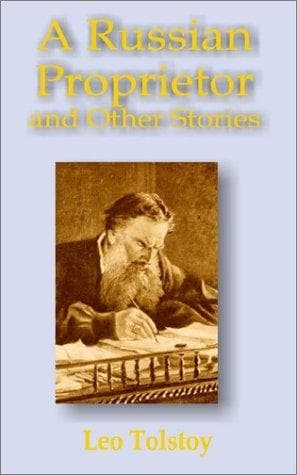
A Russian Proprietor, and Other StoriesTolstoy, Leo, graf
General
A Russian Proprietor, and Other Stories
Tolstoy, Leo, graf
Russia -- Social life and customs -- Fiction; Tolstoy, Leo, graf, 1828-1910 -- Translations into English
"Why is it that this inhuman fact, impossible in any country,--Germany,
France, or Italy,--is quite possible here where civilization, freedom, and
equality are carried to the highest degree of development, where there are
gathered together the most civilized travellers from the most civilized
nations? Why is it that these cultivated human beings, generally capable of
every honorable human action, had no hearty, human feeling for one good
deed? Why is it that these people who in their palaces, their meetings, and
their societies, labor warmly for the condition of the celibate Chinese in
India, about the spread of Christianity and culture in Africa, about the
formation of societies for attaining all perfection,--why is it that they
should not find in their souls the simple, primitive feeling of human
sympathy? Has such a feeling entirely disappeared, and has its place been
taken by vainglory, ambition, and cupidity, governing these men in their
palaces, meetings, and societies? Has the spreading of that reasonable,
egotistical association of people, which we call civilization, destroyed
and rendered nugatory the desire for instinctive and loving association?
And is this that boasted equality for which so much innocent blood has been
shed, and so many crimes have been perpetrated? Is it possible that
nations, like children, can be made happy by the mere sound of the word
'equality'?
"Equality before the law? Does the whole life of a people revolve within
the sphere of law? Only the thousandth part of it is subject to the law:
the rest lies outside of it, in the sphere of the customs and intuitions of
society.
"But in society the lackey is better dressed than the minstrel, and insults
him with impunity. I am better dressed than the lackey, and insult him with
impunity. The porter considers me higher, but the minstrel lower, than
himself; when I made the minstrel my companion, he felt that he was on an
equality with us both, and behaved rudely. I was impudent to the porter,
and the porter acknowledged that he was inferior to me. The waiter was
impudent to the minstrel, and the minstrel accepted the fact that he was
inferior to the waiter.
"And is that government free, even though men seriously call it free, where
a single citizen can be thrown into prison because, without harming any
one, without interfering with any one, he does the only thing that he can
to prevent himself from dying of starvation?
Public-domain text, read in full here on John Shaqi.
Reviews
Reviews
No reviews yet
Be the first to share your thoughts on this work.
Join the Discussion
Join the discussion
Sign in to leave a comment or review.
Sign InorCreate an account