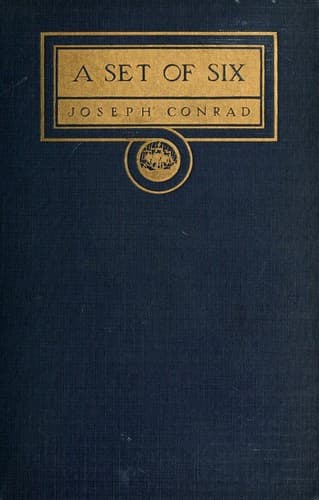
Adventure and adventurers -- Fiction; Short stories
and spare, his eyes alert in a long, Roman-nosed countenance, X walked on
his neat little feet, with short steps, and looked at my collection
intelligently. I hope I looked at him intelligently, too. A snow-white
moustache and imperial made his nutbrown complexion appear darker than it
really was. In his fur coat and shiny tall hat that terrible man looked
fashionable. I believe he belonged to a noble family, and could have
called himself Vicomte X de la Z if he chose. We talked nothing but
bronzes and porcelain. He was remarkably appreciative. We parted on
cordial terms.
</p>
<p>
Where he was staying I don’t know. I imagine he must have been a lonely
man. Anarchists, I suppose, have no families—not, at any rate, as we
understand that social relation. Organization into families may answer to
a need of human nature, but in the last instance it is based on law, and
therefore must be something odious and impossible to an anarchist. But,
indeed, I don’t understand anarchists. Does a man of that—of that—persuasion
still remain an anarchist when alone, quite alone and going to bed, for
instance? Does he lay his head on the pillow, pull his bedclothes over
him, and go to sleep with the necessity of the chambardement general, as
the French slang has it, of the general blow-up, always present to his
mind? And if so how can he? I am sure that if such a faith (or such a
fanaticism) once mastered my thoughts I would never be able to compose
myself sufficiently to sleep or eat or perform any of the routine acts of
daily life. I would want no wife, no children; I could have no friends, it
seems to me; and as to collecting bronzes or china, that, I should say,
would be quite out of the question. But I don’t know. All I know is that
Mr. X took his meals in a very good restaurant which I frequented also.
</p>
<p>
With his head uncovered, the silver top-knot of his brushed-up hair
completed the character of his physiognomy, all bony ridges and sunken
hollows, clothed in a perfect impassiveness of expression. His meagre
brown hands emerging from large white cuffs came and went breaking bread,
pouring wine, and so on, with quiet mechanical precision. His head and
body above the tablecloth had a rigid immobility. This firebrand, this
great agitator, exhibited the least possible amount of warmth and
animation. His voice was rasping, cold, and monotonous in a low key. He
could not be called a talkative personality; but with his detached calm
manner he appeared as ready to keep the conversation going as to drop it
at any moment.
</p>
<p>
And his conversation was by no means commonplace. To me, I own, there was
Public-domain text, read in full here on John Shaqi.
Reviews
Reviews
No reviews yet
Be the first to share your thoughts on this work.
Join the Discussion
Join the discussion
Sign in to leave a comment or review.
Sign InorCreate an account