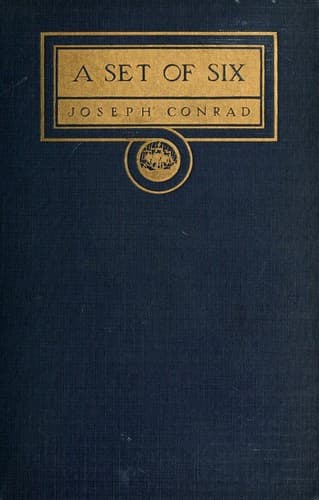
Adventure and adventurers -- Fiction; Short stories
Fancy having it brought home to her so brutally that
she was the sort of person who must run away from the police! I believe
she was pale with indignation, mostly, though there was, of course, also
the concern for her intact personality, a vague dread of some sort of
rudeness. And, naturally, she turned to a man, to the man on whom she had
a claim of fascination and homage—the man who could not conceivably
fail her at any juncture.”
</p>
<p>
“But,” I cried, amazed at this analysis, “if it had been serious, real, I
mean—as she thought it was—what could she expect him to do for
her?”
</p>
<p>
X never moved a muscle of his face.
</p>
<p>
“Goodness knows. I imagine that this charming, generous, and independent
creature had never known in her life a single genuine thought; I mean a
single thought detached from small human vanities, or whose source was not
in some conventional perception. All I know is that after advancing a few
steps she extended her hand towards the motionless Sevrin. And that at
least was no gesture. It was a natural movement. As to what she expected
him to do, who can tell? The impossible. But whatever she expected, it
could not have come up, I am safe to say, to what he had made up his mind
to do, even before that entreating hand had appealed to him so directly.
It had not been necessary. From the moment he had seen her enter that
cellar, he had made up his mind to sacrifice his future usefulness, to
throw off the impenetrable, solidly fastened mask it had been his pride to
wear—”
</p>
<p>
“What do you mean?” I interrupted, puzzled. “Was it Sevrin, then, who was—”
</p>
<p>
“He was. The most persistent, the most dangerous, the craftiest, the most
systematic of informers. A genius amongst betrayers. Fortunately for us,
he was unique. The man was a fanatic, I have told you. Fortunately, again,
for us, he had fallen in love with the accomplished and innocent gestures
of that girl. An actor in desperate earnest himself, he must have believed
in the absolute value of conventional signs. As to the grossness of the
trap into which he fell, the explanation must be that two sentiments of
such absorbing magnitude cannot exist simultaneously in one heart. The
danger of that other and unconscious comedian robbed him of his vision, of
his perspicacity, of his judgment. Indeed, it did at first rob him of his
self-possession. But he regained that through the necessity—as it
appeared to him imperiously—to do something at once. To do what?
Why, to get her out of the house as quickly as possible. He was
desperately anxious to do that. I have told you he was terrified.
Public-domain text, read in full here on John Shaqi.
Reviews
Reviews
No reviews yet
Be the first to share your thoughts on this work.
Elsewhere in the archive
Join the Discussion
Join the discussion
Sign in to leave a comment or review.
Sign InorCreate an account