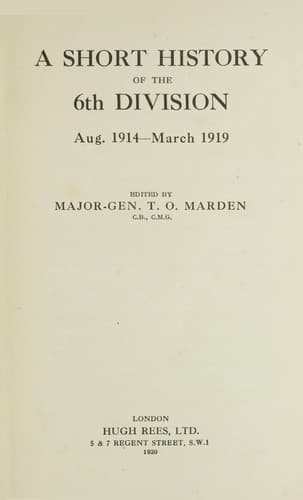
A Short History of the 6th Division: Aug. 1914-March 1919
History
A Short History of the 6th Division: Aug. 1914-March 1919
Great Britain. Army. Division, 6th; World War, 1914-1918 -- Campaigns -- Western Front; World War, 1914-1918 -- Regimental histories -- Great Britain
To the 18th Infantry Brigade was entrusted the task of securing a line
well clear of Holnon Wood for the forming-up line on the 18th, and in
doing so it first had to clear the wood and establish posts at the
edge, then push forward. The selected forming-up line included to us
Holnon Village on the right and next to the French.
On the morning of the 16th September the 11th Essex, after an
unsuccessful attempt to push forward during the night, attacked under
a barrage and advanced from the line of posts taken over a little way
inside the wood to a line of trenches just clear of the wood,
capturing in this small operation forty-six prisoners. It was now
arranged for the 1st, 6th and 34th (French) Divisions to advance
simultaneously to secure the above-mentioned starting line. On the
left the 1st Division was successful, and so were the 11th Essex, who,
held up at first by heavy shelling and machine-gun fire, persevered
throughout the day and were rewarded by finishing up in possession of
the whole of their objectives, a very creditable performance.
On the right the West Yorks had to secure Holnon Village, which lay in
a hollow commanded by Round and Manchester Hills in the area allotted
to the French, and which was itself strongly held. The French failed
in their attack, and though the West Yorks obtained part of the
village they could not clear it and establish the starting line
beyond it. The situation at the end of the 17th was therefore
unsatisfactory on the right, but it was impossible to put off the
general attack, and arrangements had to be improvised. Another
unsatisfactory feature was that Holnon Wood covered practically the
whole 2,500 yards frontage of the Division, and was so drenched with
gas shells and the tracks so bad, that both 16th and 71st Infantry
Brigades had to make a detour north and south of the wood respectively
to reach their assembly positions, and this naturally fatigued the
troops and hindered communication and supply.
Standing on the east edge of the wood, a bare glacis-like slope devoid
of cover, except for two or three shell-trap copses, stretched away
for 3,000 yards to the high ground overlooking St. Quentin. There was
no sign of life and very few trenches could be seen, though it was
known that they were there as the Fifth Army had held the position in
March 1918. It was found afterwards that the Germans had camouflaged
their trenches with thistles, which here covered the ground to a
height in many places of eighteen inches.
Public-domain text, read in full here on John Shaqi.
Reviews
Reviews
No reviews yet
Be the first to share your thoughts on this work.
Join the Discussion
Join the discussion
Sign in to leave a comment or review.
Sign InorCreate an account