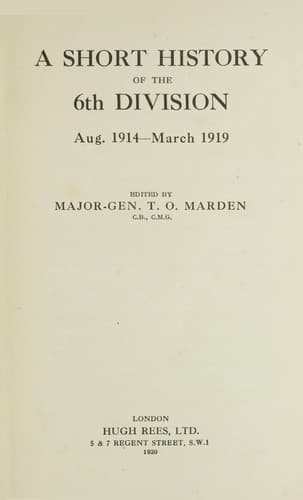
A Short History of the 6th Division: Aug. 1914-March 1919
History
A Short History of the 6th Division: Aug. 1914-March 1919
Great Britain. Army. Division, 6th; World War, 1914-1918 -- Campaigns -- Western Front; World War, 1914-1918 -- Regimental histories -- Great Britain
At the highest point about the centre of the Divisional area of attack
was a network of trenches known later as the Quadrilateral--a name of
bad omen to the 6th Division--and which, like its namesake on the
Somme, could be reinforced under cover from the back slopes of the
hill. An examination of the battlefield after the 24th September also
revealed several narrow sunken roads filled with wire. The position
was one of great natural strength, and in addition the whole of the
right was dominated by heights in the area to be attacked by the
French. Lastly, adequate time could not be given to Brigades for
reconnaissance owing to the imperative necessity of pushing on to
guard the flank of Corps farther north. Troops had not seen the ground
they had to attack over, and rain and smoke obscured the few landmarks
existing on 18th September.
On that morning the Division attacked at 5.20 a.m. with the 71st
Infantry Brigade on the right, its left directed on the Quadrilateral
and its right on Holnon and Selency.
The 16th Infantry Brigade was on the left, with its right just clear
of the Quadrilateral and its left on Fresnoy le Petit. Six tanks were
allotted to the Division, but met with various mishaps or were knocked
out, and were not of much use. The attack met with most determined
opposition at once, especially on the right, where the difficulties of
the 71st Infantry Brigade were increased by the failure of the French
to take Round and Manchester Hills.
The 2nd D.L.I., attached to this brigade to complete the clearing of
Holnon Village, accomplished this, but were driven out by shelling and
by machine gun fire from Round and Manchester Hills, losing very
heavily.
The 16th Infantry Brigade was more successful, and at one time the
York and Lancasters had nearly completed the capture of Fresnoy le
Petit, but were unable to hold it. The brigade advanced, however,
3,000 yards. Fighting was continuous throughout the day, but without
further success. The Sherwood Foresters advancing very gallantly
against the Quadrilateral were reported as being just outside it and
entrenched. It was machine gun fire from this stronghold which
prevented the right of the 16th Infantry Brigade advancing, and an
attack was therefore ordered for dawn of the 19th September, but it
was evidently anticipated by the enemy, who put down a very heavy
artillery and machine-gun barrage before the attackers left their
jumping-off positions. Fighting again continued throughout the day,
but without success, and it was evident that the enemy meant standing
his ground and that this was not a rearguard action as it had at one
time been thought. The enemy's artillery was very strong, and, with
the thick Hindenburg wire in front of it, was placed close to their
front line, and was enabled thus to do considerable execution on
our back areas.
Public-domain text, read in full here on John Shaqi.
Reviews
Reviews
No reviews yet
Be the first to share your thoughts on this work.
Join the Discussion
Join the discussion
Sign in to leave a comment or review.
Sign InorCreate an account