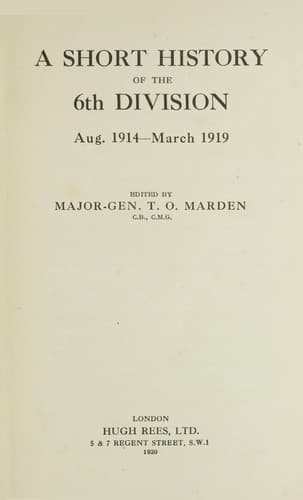
A Short History of the 6th Division: Aug. 1914-March 1919
History
A Short History of the 6th Division: Aug. 1914-March 1919
Great Britain. Army. Division, 6th; World War, 1914-1918 -- Campaigns -- Western Front; World War, 1914-1918 -- Regimental histories -- Great Britain
While the 6th Division had been fighting on the right of the British
Army, the 46th Division, with the Americans on their left and the 1st
Division forming a defensive flank on their right, had broken the
Hindenburg Line on 29th September by a magnificent attack. Followed
across the canal by the 32nd Division, these two divisions had
very severe fighting at Ramicourt and Sequehart and were exhausted.
The 6th Division, after four days to rest and absorb reinforcements,
was ordered to relieve them and attack on the 8th October in the
direction of the small town of Bohain. The 30th American Division was
on the right and about 2,000 yards ahead, connected to the 6th
Division by a series of posts along the railway. This curious position
entailed a very complicated creeping barrage, which, however, was
successfully put into operation on the day of the attack. On the right
was the French 42nd Division slightly in rear, having followed the
Germans through St. Quentin and met with strong resistance beyond it.
The position to be attacked consisted of high rolling downs with deep
traverse valleys, giving good cover for supports and forward guns, and
on the right a broad longitudinal valley closed by a ridge on which
stood the village of Mericourt. The French had a stiff task in front
of them, and did not propose to advance as far as the British--6,000
yards--with the result that even if they were successful our frontage,
thrown back from left to right, would be 7,500 yards, and if
unsuccessful over 10,000. Added to this their zero hour was nearly an
hour after ours, and there would be a very real danger of
counter-attack from the right. The Divisional Commander, therefore,
decided to leave the valley severely alone to start with, merely
smoking by guns and bombs from aeroplanes the Mericourt Ridge and
attacking all along the high ground on the north. As our attack and
the French attack progressed the valley was to be cleared by three
whippet tanks supported by the 1st Battalion West Yorks, lent to the
16th Infantry Brigade, while finally an attack from the high ground
against the Mericourt Ridge would be delivered with a view to cutting
off posts in the valley between the two attacks. The 139th Infantry
Brigade of the 46th Division remained in position at Sequehart,
together with two companies Life Guards Machine-gun Battalion, to
secure the right flank against counter-attack. The machine-gun
nests on the Sequehart-Mericourt road enfiladed the start line of the
6th Division, and the G.O.C., 139th Infantry Brigade (Brig-Gen. J.
Harington), was asked to capture these just before the general attack.
The 46th Divisional Pioneer Battalion (1/1st Monmouthshire Regiment)
undertook this task, and twice attacked the position but without
success, in spite of the greatest gallantry. The Commanding Officer
(Col. Jenkins) and his Adjutant were both unfortunately killed. Their
bravery, however, was well rewarded, as their action enabled the 6th
Public-domain text, read in full here on John Shaqi.
Reviews
Reviews
No reviews yet
Be the first to share your thoughts on this work.
Join the Discussion
Join the discussion
Sign in to leave a comment or review.
Sign InorCreate an account