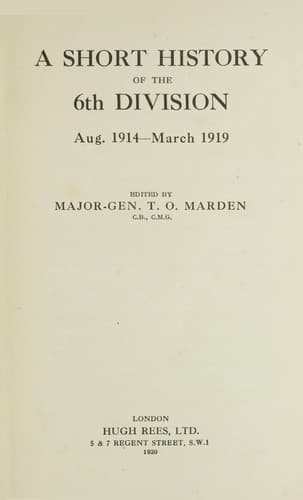
A Short History of the 6th Division: Aug. 1914-March 1919
History
A Short History of the 6th Division: Aug. 1914-March 1919
Great Britain. Army. Division, 6th; World War, 1914-1918 -- Campaigns -- Western Front; World War, 1914-1918 -- Regimental histories -- Great Britain
During the night this brigade was relieved by the 16th Infantry
Brigade (Brig.-Gen. W. G. Braithwaite), which resumed the attack on
the morning of the 24th October. Opposition had by this time
decreased, and better progress was made, so that by noon the right
battalion, the 2nd York and Lancaster Regiment, held the line of
the objective laid down for the previous day's attack, and the left
battalion of the 18th Infantry Brigade had also completed the capture
of its objective. Some further progress was made during the day by the
16th Infantry Brigade.
During the period 20th to 24th October, Brig.-Gen. E. F. Delaforce,
C.R.A., 6th Division, had under his orders the Divisional Artillery of
the 3rd, 4th and 5th Australian Divisions, though the 5th Australian
Divisional Artillery was withdrawn on the eve of the attack of 24th
October. Their fire was most accurate and prompt, and gave the
attacking infantry every confidence. The 6th D.A. on this occasion was
in Corps Reserve.
During the 26th, 27th and 28th the patrols of the 16th Infantry
Brigade continued to work their way slowly forward, and the village of
Ors was evacuated of its inhabitants under the protection of patrols
of the 18th Infantry Brigade. The latter established a bridge-head
across the canal at Ors, and posts on the west side commanding the
canal on the whole brigade front.
On the 29th orders were received for the relief of the Division. In
order to be able to hand over to the relieving Division a satisfactory
position from which to launch the attack on the line of the canal, a
further small operation was planned by the 16th Infantry Brigade, and
brilliantly carried out by the 1st The Buffs on the 30th October. Two
companies attacked and captured an important farm and spur overlooking
the canal, were counter-attacked in the afternoon and turned out of
the farm, but retook it at once with the bayonet, inflicting heavy
casualties on the enemy and capturing five more machine-guns.
On the night of the 30th/31st October the relief of the Division (less
artillery) was completed, and it withdrew to billets in Fresnoy le
Grand, whence it moved some days later to Bohain.
The captures during the fighting from the 19th to the 31st October
numbered 9 officers and 431 other ranks, 13 guns (including two 5.9-in.
howitzers), 12 trench-mortars, and 61 machine-guns.
The total captures during a period of between six and seven weeks, in
which the Division had seen much stiff fighting, and had suffered over
6,000 casualties, amounted to 96 officers, 3,505 other ranks, 32 guns,
52 trench-mortars, and 527 machine-guns counted.
The infantry of the Division saw no more fighting, but its artillery
remained in till the end, finishing up in the neighbourhood of
Avesnes.
Public-domain text, read in full here on John Shaqi.
Reviews
Reviews
No reviews yet
Be the first to share your thoughts on this work.
Elsewhere in the archive
Join the Discussion
Join the discussion
Sign in to leave a comment or review.
Sign InorCreate an account