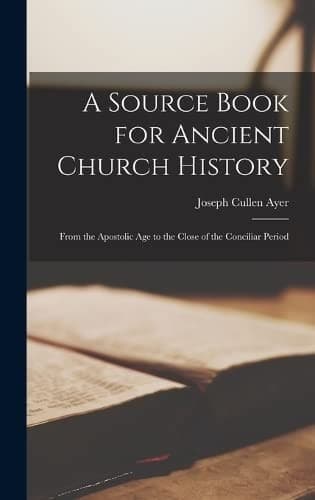
A Source Book for Ancient Church HistoryAyer, Joseph Cullen
History
A Source Book for Ancient Church History
Ayer, Joseph Cullen
Church history -- Primitive and early church, ca. 30-600 -- Sources
The _Apology_ of Aristides was long lost, but was found in a
Syriac version in 1889. It was then found that much of the Greek
original had been incorporated in the _Life of Barlaam and
Josaphat_, a popular religious romance of the Middle Ages; see the
introduction to the parallel translations by D. H. McKay in ANF,
vol. IX, 259-279. This work of Aristides may be as early as 125;
if so, it disputes with the similar work of Quadratus the honor of
being the first Christian apology. A large part of it is taken up
with a statement of the contradictions and absurdities of the
mythology of the Greeks and Barbarians. Of this statement, ch. 13,
quoted below, is the conclusion. Then, after a short passage
regarding the Jews, the author passes to an exposition of the
faith of Christians and a statement regarding their high morality.
Ch. 2. [Found only in Syriac.] The Christians trace the beginning of their
religion to Jesus the Messiah; and He is named the Son of the most high
God. And it is said that God came down from heaven and from a Hebrew
virgin assumed and clothed Himself with flesh, and that the Son of God
lived in a daughter of man. This is taught in that Gospel which, as is
related among them, was preached among them a short time ago. And you,
also, if you will read therein, may perceive the power that belongs to it.
This Jesus, therefore, was born of the race of the Hebrews. He had twelve
disciples, that His wonderful plan of salvation might be carried out. But
He himself was pierced by the Jews, and He died and He was buried. And
they say that after three days He rose and was raised to heaven. Thereupon
those twelve disciples went forth into the known parts of the world, and
with all modesty and uprightness taught concerning His greatness. And
therefore also those at the present time who now believe that preaching
are called Christians and they are known.
Ch. 13. When the Greeks made laws they did not perceive that by their laws
they condemned their gods. For if their laws are righteous, their gods are
unrighteous, because they committed transgressions of the law in that they
killed one another, practised sorcery, and committed adultery, robbed,
stole, and lay with males, not to mention their other practices. For if
their gods have done right in doing all this, as they write, then the laws
of the Greeks are unrighteous in not being made according to the will of
their gods. And consequently the whole world has gone astray.
Public-domain text, read in full here on John Shaqi.
Reviews
Reviews
No reviews yet
Be the first to share your thoughts on this work.
Join the Discussion
Join the discussion
Sign in to leave a comment or review.
Sign InorCreate an account