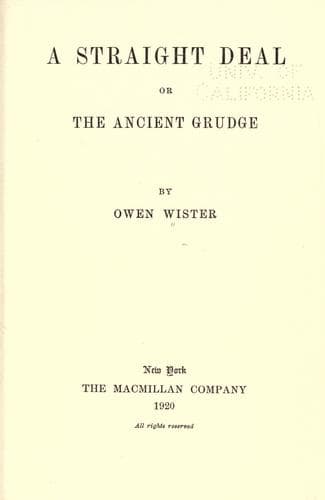
A Straight Deal; Or, The Ancient GrudgeWister, Owen
History
A Straight Deal; Or, The Ancient Grudge
Wister, Owen
Great Britain -- Relations -- United States; United States -- Relations -- Great Britain
It was in a very brief visit that Beecher managed to see England as she
was: a remarkable letter for its insight, and more remarkable still for
its moderation, when you consider that it was written in the midst of
our Civil War, while loyal Americans were not only enraged with England,
but wounded to the quick as well. When a man can do this--can have
passionate convictions in passionate times, and yet keep his judgment
unclouded, wise, and calm, he serves his country well.
I can remember the rage and the wound. In that atmosphere I began my
existence. My childhood was steeped in it. In our house the London Punch
was stopped, because of its hostile ridicule. I grew to boyhood hearing
from my elders how England had for years taunted us with our tolerance
of slavery while we boasted of being the Land of the Free--and then,
when we arose to abolish slavery, how she “jack-knived” and gave aid and
comfort to the slave power when it had its fingers upon our throat. Many
of that generation of my elders never wholly got over the rage and the
wound. They hated all England for the sake of less than half England.
They counted their enemies but never their friends. There’s nothing
unnatural about this, nothing rare. On the contrary, it’s the usual,
natural, unjust thing that human nature does in times of agony. It’s the
Henry Ward Beechers that are rare. In times of agony the average man and
woman see nothing but their agony. When I look over some of the letters
that I received from England in 1915--letters from strangers evoked by
a book called The Pentecost of Calamity, wherein I had published my
conviction that the cause of England was righteous, the cause of Germany
hideous, and our own persistent neutrality unworthy--I’m glad I lost my
temper only once, and replied caustically only once. How dreadful (wrote
one of my correspondents) must it be to belong to a nation that was
behaving like mine! I retorted (I’m sorry for it now) that I could
all the more readily comprehend English feeling about our neutrality,
because I had known what we had felt when Gladstone spoke at Newcastle
and when England let the Alabama loose upon us in 1862. Where was the
good in replying at all? Silence is almost always the best reply in
these cases. Next came a letter from another English stranger, in which
the writer announced having just read The Pentecost of Calamity. Not
a word of friendliness for what I had said about the righteousness of
England’s cause or my expressed unhappiness over the course which our
Government had taken--nothing but scorn for us all and the hope that we
should reap our deserts when Germany defeated England and invaded us.
Well? What of it? Here was a stricken person, writing in stress, in a
land of desolation, mourning for the dead already, waiting for the next
who should die, a poor, unstrung average person, who had not long before
read that remark of our President’s made on the morrow of the Lusitania:
Public-domain text, read in full here on John Shaqi.
Reviews
Reviews
No reviews yet
Be the first to share your thoughts on this work.
Join the Discussion
Join the discussion
Sign in to leave a comment or review.
Sign InorCreate an account