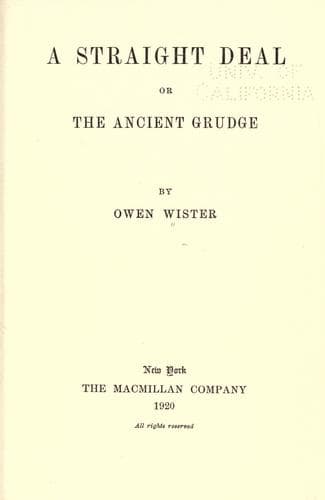
A Straight Deal; Or, The Ancient GrudgeWister, Owen
History
A Straight Deal; Or, The Ancient Grudge
Wister, Owen
Great Britain -- Relations -- United States; United States -- Relations -- Great Britain
that there is such a thing as being too proud to fight; had read during
the ensuing weeks those notes wherein we stood committed by our Chief
Magistrate to a verbal slinking away and sitting down under it. Can you
wonder? If the mere memory of those days of our humiliation stabs
me even now, I need no one to tell me (though I have been told) what
England, what France, felt about us then, what it must have been like
for Americans who were in England and France at that time. No: the
average person in great trouble cannot rise above the trouble and survey
the truth and be just. In English eyes our Government--and therefore all
of us--failed in 1914--1915--1916--failed again and again--insulted the
cause of humanity when we said through our President in 1916, the third
summer of the war, that we were not concerned with either the causes
or the aims of that conflict. How could they remember Hoover, or Robert
Bacon, or Leonard Wood, or Theodore Roosevelt then, any more than we
could remember John Bright, or Richard Cobden, or the Manchester men in
the days when the Alabama was sinking the merchant vessels of the Union?
We remembered Lord John Russell and Lord Palmerston in the British
Government, and their fellow aristocrats in British society; we
remembered the aristocratic British press--The Times notably, because
the most powerful--these are what we saw, felt, and remembered, because
they were not with us, and were able to hurt us in the days when our
friends were not yet able to help us. They made welcome the Southerners
who came over in the interests of the South, they listened to the
Southern propaganda. Why? Because the South was the American version of
their aristocratic creed. To those who came over in the interests of
the North and of the Union they turned a cold shoulder, because they
represented Democracy; moreover, a Dis-United States would prove in
commerce a less formidable competitor. To Captain Bullock, the able
and energetic Southerner who put through in England the building
and launching of those Confederate cruisers which sank our ships and
destroyed our merchant marine, and to Mason and Slidell, the doors of
dukes opened pleasantly; Beecher and our other emissaries mostly had to
dine beneath uncoroneted roofs.
In the pages of Henry Adams, and of Charles Francis Adams his brother,
you can read of what they, as young men, encountered in London, and
what they saw their father have to put up with there, both from English
society and the English Government. Their father was our new minister to
England, appointed by Lincoln. He arrived just after our Civil War had
begun. I have heard his sons talk about it familiarly, and it is all to
be found in their writings.
Public-domain text, read in full here on John Shaqi.
Reviews
Reviews
No reviews yet
Be the first to share your thoughts on this work.
Join the Discussion
Join the discussion
Sign in to leave a comment or review.
Sign InorCreate an account