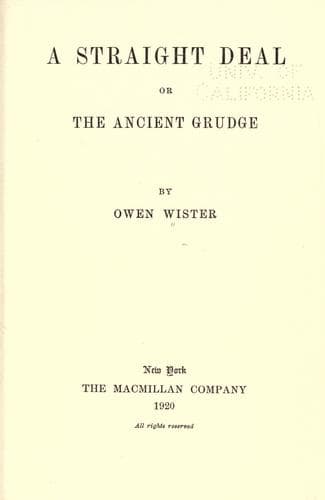
A Straight Deal; Or, The Ancient Grudge — John Shaqi
A Straight Deal; Or, The Ancient GrudgeWister, Owen
History
A Straight Deal; Or, The Ancient Grudge
Wister, Owen
Great Britain -- Relations -- United States; United States -- Relations -- Great Britain
Nobody knows how to be disagreeable quite so well as the English
gentleman, except the English lady. They can do it with the nicety of a
medicine dropper. They can administer the precise quantum suff. in every
case. In the society of English gentlemen and ladies Mr. Adams by his
official position was obliged to move. They left him out as much as
they could, but, being the American Minister, he couldn’t be left
out altogether. At their dinners and functions he had to hear open
expressions of joy at the news of Southern victories, he had to receive
slights both veiled and unveiled, and all this he had to bear with
equanimity. Sometimes he did leave the room; but with dignity and
discretion. A false step, a “break,” might have led to a request for
his recall. He knew that his constant presence, close to the English
Government, was vital to our cause. Russell and Palmerston were by
turns insolent and shifty, and once on the very brink of recognizing the
Southern Confederacy as an independent nation. Gladstone, Chancellor of
the Exchequer, in a speech at Newcastle, virtually did recognize it. You
will be proud of Mr. Adams if you read how he bore himself and fulfilled
his appallingly delicate and difficult mission. He was an American who
knew how to behave himself, and he behaved himself all the time; while
the English had a way of turning their behavior on and off, like the
hot water. Mr. Adams was no admirer of “shirt-sleeves” diplomacy. His
diplomacy wore a coat. Our experiments in “shirt-sleeves” diplomacy fail
to show that it accomplishes anything which diplomacy decently dressed
would not accomplish more satisfactorily. Upon Mr. Adams fell some
consequences of previous American crudities, of which I shall speak
later.
Lincoln had declared a blockade on Southern ports before Mr. Adams
arrived in London. Upon his arrival he found England had proclaimed her
neutrality and recognized the belligerency of the South. This dismayed
Mr. Adams and excited the whole North, because feeling ran too high to
perceive this first act on England’s part to be really favorable to us;
she could not recognize our blockade, which stopped her getting Southern
cotton, unless she recognized that the South was in a state of war with
us. Looked at quietly, this act of England’s helped us and hurt herself,
for it deprived her of cotton.
It was not with this, but with the reception and treatment of Mr. Adams
that the true hostility began. Slights to him were slaps at us, sympathy
with the South was an active moral injury to our cause, even if it was
mostly an undertone, politically. Then all of a sudden, something that
we did ourselves changed the undertone to a loud overtone, and we just
grazed England’s declaring war on us. Had she done so, then indeed it
had been all up with us. This incident is the comic going-back on our
own doctrine of 1812, to which I have alluded above.
Public-domain text, read in full here on John Shaqi.
Reviews
Reviews
No reviews yet
Be the first to share your thoughts on this work.
Join the Discussion
Join the discussion
Sign in to leave a comment or review.
Sign InorCreate an account