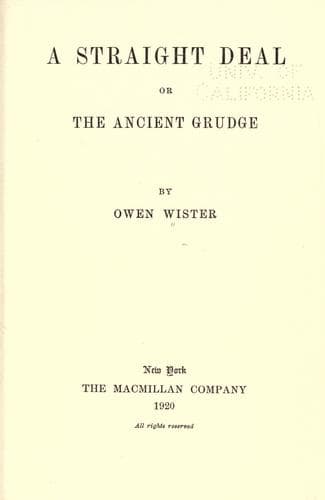
A Straight Deal; Or, The Ancient GrudgeWister, Owen
History
A Straight Deal; Or, The Ancient Grudge
Wister, Owen
Great Britain -- Relations -- United States; United States -- Relations -- Great Britain
Next, Lord Cromer, at Port Said, stretched out the arm of international
law, and laid it upon the Spanish fleet. Belligerents may legally take
coal enough at neutral ports to reach their nearest “home port.” That
Spanish fleet was on its way from Spain to Manila through the Suez
Canal. It could have reached there, had Lord Cromer allowed it coal
enough to make the nearest home port ahead of it--Manila. But there was
a home port behind it, still nearer, namely, Barcelona. He let it take
coal enough to get back to Barcelona. Thus, England again stepped in.
The third time was in Manila Bay itself, after Dewey’s victory, and
while he was in occupation of the place. Once more the Kaiser tried
it, not discouraged by his failure with Mr. Balfour and the British
Government. He desired the Philippines for himself; we had not yet
acquired them; we were policing them, superintending the harbor,
administering whatever had fallen to us from Spain’s defeat. The Kaiser
sent, under Admiral Diedrich, a squadron stronger than Dewey’s.
Dewey indicated where the German was to anchor. “I am here by the order
of his Majesty the German Emperor,” said Diedrich, and chose his own
place to anchor. He made it quite plain in other ways that he was taking
no orders from America. Dewey, so report has it, at last told him that
“if he wanted a fight he could have it at the drop of the hat.” Then it
was that the German called on the English Admiral, Chichester, who was
likewise at hand, anchored in Manila Bay. “What would you do,” inquired
Diedrich, “in the event of trouble between Admiral Dewey and myself?”
“That is a secret known only to Admiral Dewey and me,” said the
Englishman. Plainer talk could hardly be. Diedrich, though a German,
understood it. He returned to his flagship. What he saw next morning
was the British cruiser in a new place, interposed between Dewey and
himself. Once more, he understood; and he and his squadron sailed off;
and it was soon after this incident that the disappointed Kaiser wrote
that, if only his fleet had been larger, he would have taken us by the
scruff of the neck.
Tell these things to the next man you hear talking about George III
or the Alabama. You may meet him in front of a bulletin board, or in
a drawing-room. He is amongst us everywhere, in the street and in the
house. He may be a paid propagandist or merely a silly ignorant puppet.
But whatever he is, he will not find much to say in response, unless it
be vain, sterile chatter. True come-back will fail him as it failed that
man by the bulletin board who asked, “What is England doing, anyhow?”
and his neighbor answered, “Her fleet’s keeping the Kaiser out of your
front yard.”
Chapter XIV: England the Slacker!
What did England do in the war, anyhow?
Public-domain text, read in full here on John Shaqi.
Reviews
Reviews
No reviews yet
Be the first to share your thoughts on this work.
Elsewhere in the archive
Join the Discussion
Join the discussion
Sign in to leave a comment or review.
Sign InorCreate an account