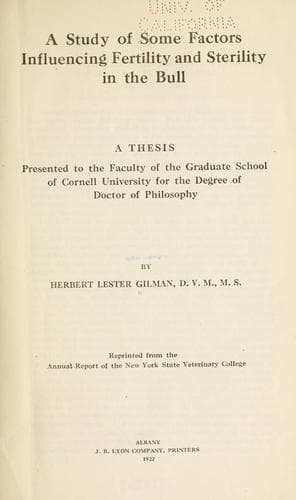
A study of some factors influencing fertility and sterility in the bullGilman, Herbert Lester
Science
A study of some factors influencing fertility and sterility in the bull
Gilman, Herbert Lester
Cattle; Infertility in animals; Livestock; Thesis (Ph. D.)
Vaginal smears taken before and after service, in many instances, show
that in all probability bacteria, especially the streptococci, were
deposited there with the semen. These results have been obtained upon
several occasions, at which time the vagina was usually douched prior to
each service with sterile saline solution. Streptococci and other
organisms have been isolated from the vaginal samples obtained by this
method. In most cases, they were absent from samples taken before
service. Extraneous contamination, and error, must be taken into
consideration, but the results tend to bear out clinical observations
that the bull is probably a disseminator of some infections associated
with the genital organs of both sexes. At any rate, organisms have been
isolated repeatedly from the genital organs of the bull, of the same
biological character as those which are associated with sterility,
abortion, and allied phenomena in the female. In the absence of
obstruction in any part of the tract, there is nothing to hinder
infection from gaining access to the seminal fluid, and being excreted
during ejaculation.
Hopper (18) states: “A diseased bull may manifest non-fertility or
decreased potency in different ways—by repeated service to apparently
normal females without conception, by a high abortion rate in females
that have been apparently normal, by characteristic infections following
the use of any particular sire, or by abnormalities in the breeding
tract noted by rectal or physical palpation.”
Admittedly, _Bact. abortum_ has little affinity for the genitalia of the
bull, though Schroeder states that the bull harbors the organisms in his
seminal vesicles and that they are eliminated with the semen. Other
authors have occasionally isolated the organism from the vesicles,
testes, or both. Schroeder’s theory that infection of the female occurs
indirectly by contamination of the fodder with the semen is probably
rare in occurrence. The very limited number of cases in which
investigators have demonstrated the presence of the organism in the male
genital organs, and the apparent immunity of the bull to the bacterium
as determined by the agglutination reaction, seem to indicate that he
plays a small part in the spread of this type of infection in the herd.
On the other hand, it would seem that he is at times intimately
associated with the spread of certain other organisms that interfere
seriously with herd reproductivity.
Public-domain text, read in full here on John Shaqi.
Reviews
Reviews
No reviews yet
Be the first to share your thoughts on this work.
Elsewhere in the archive
Join the Discussion
Join the discussion
Sign in to leave a comment or review.
Sign InorCreate an account