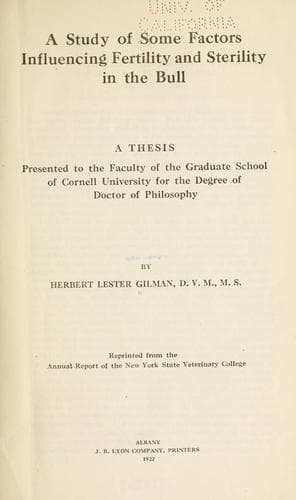
A study of some factors influencing fertility and sterility in the bullGilman, Herbert Lester
Science
A study of some factors influencing fertility and sterility in the bull
Gilman, Herbert Lester
Cattle; Infertility in animals; Livestock; Thesis (Ph. D.)
The early precipitation out of the “Boettcherchen” crystals is very
characteristic of oligospermia, and impotent semen. The theory here is
that crystals do not precipitate out when a fluid is actively moving,
but soon do so when the fluid is motionless. The sediment which normally
makes up about two-thirds of the sample is usually decreased in abnormal
samples. The semen itself should be observed for unusual viscosity or a
thin watery condition. Clotting should occur readily after emission, but
the clot soon liquefies to some extent, allowing the spermatozoa to
become more active. This clotting is, of course, to protect the delicate
sperms from the hostile secretions of the vagina.
The presence of immature and deformed types of sperms represents some
disturbance of spermatogenesis, but it is difficult to explain the
significance of these forms. They are seldom seen in normal samples, and
undoubtedly none are capable of producing impregnation. In the case of
minor abnormalities of staining reactions, the sperms are probably
deficient in nuclear material or otherwise altered so that probably they
are incapable of reaching and uniting with the ovum. When impregnation
does occur in these cases, weak offspring undoubtedly result in many
instances.
The work has by no means progressed to the point where one may, by an
examination of the semen, determine the degree of impotency with great
accuracy, or even whether the animal may be restored to sexual health by
proper hygienic and therapeutic treatment. Relatively, the greater the
changes in the semen and spermatozoa, the less the chances of
impregnation. Infertility to any marked degree, is, however, usually
accompanied by corresponding changes in the seminal fluid and its
germinal elements.
Examination of the semen is, and probably always will be, simply an aid
in reaching a diagnosis. While abnormalities of the semen and
spermatozoa are associated with sterility or infertility, it is unwise
to lay too much emphasis upon this method of diagnosis alone, especially
with regard to the making of a definite prognosis. When large numbers of
abnormal spermatozoa are present in the semen, we are safe in saying
that the animal is, at the time, of lowered degree of fertility. One
should be very cautious, however, in foretelling how long the condition
will last, or if the animal may in time be restored to full fertility.
Sterility, due to organic disturbances, probably seldom yields to
treatment, but when it is due to functional disorders resulting from
defective diet or lack of exercise, the condition is frequently remedied
by overcoming the cause. Lack of exercise and overfeeding seem to be
etiological factors in a fair percentage of cases.
Public-domain text, read in full here on John Shaqi.
Reviews
Reviews
No reviews yet
Be the first to share your thoughts on this work.
Elsewhere in the archive
Join the Discussion
Join the discussion
Sign in to leave a comment or review.
Sign InorCreate an account