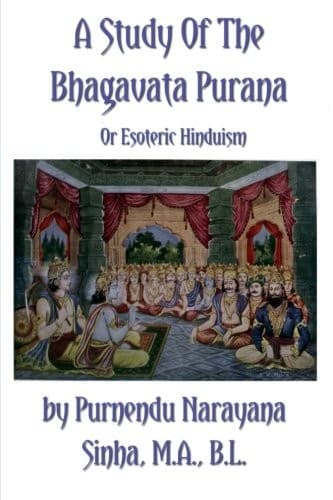
A Study of the Bhâgavata Purâna; or, Esoteric Hinduism
Religion
A Study of the Bhâgavata Purâna; or, Esoteric Hinduism
Puranas. Bhagavatapurana. English
Asanâ_
| |
| +−−−−−−−−−−+
| | |
| Vâna 100 Sons
|
+−− Hiranyâksha
|
+−− 49 Maruts
GENERAL REMARKS ON THE TABLES.
These Tables must not be mistaken for human genealogies. The reader will
have to carry himself in imagination to a time when there was a vast
sheet of nebulous mass, when the globes and planets had not been formed,
and the phenomena now known as day, night, year, month and season were
still unknown.
The process known as Pralaya had absorbed the life energies of Trilokî,
which remained latent in that intermediate plane between the higher and
the lower Lokas known as Mahar Loka. When the creative process set in,
and the ground was prepared for the manifestation of life, life energies
streamed forth from the Mahar Loka, more as types than as individuals.
These types are called Prajâpatis or the Lords of life kingdoms. They
carry back to Trilokî all the life energies of the previous Kalpa. At
Pralaya, they draw back unto themselves all the life energies of the
dying Trilokî, and take a lasting sleep in the archetypal plane ( Mahar
Loka ) to which they properly belong. The Prajâpatis of the First
Manvantara become the Rishis of other Manvantaras. As the first Lords of
creation bring back the life energies as well as the lost experiences of
the previous Kalpa, so the Rishis bring back the lost knowledge of each
Manvantara. This is fully explained in the fourteenth Chapter of the
Eighth Skandha. The Kumârs are not Prajâpatis, as they come from a plane
higher than Mahar Loka. In the first Manvantara, Marichî, Atrî Angirasa,
Pulastya, Pulaha, Kratu, Bhrigu, Vasistha, Daksha, and Nârada are
mentioned as the chief Prajâpatis. Of these, Nârada is not strictly
speaking a Prajâpati, or Lord of creation, as he took no part in the
work of creation, though he is called so having proceeded from Mahar
Loka. Kardama, Ruchi and Visvakarmâ are some of the other Prajâpatis.
Of the Prajâpatis, seven form distinct types by themselves. They preside
over the seven stars, which form the constellation of Great Bear. They
send forth their energies from the plane of the Seven Sages, and guide
the course of life evolution that takes place in Trilokî. The sages are
relieved every Manvantara by others who take up their place. The seven
sages of our Manvantara, are different from the Prajâpatis of the first
Manvantara. It is by great sacrifices and by great efforts that the
highest Rishis of a Manvantara attain the position of the Seven Sages.
The Sages may become Prajâpatis, and Prajâpatis may become Kumâras. And
men may become sages, if they follow the true path. The grades that
divide men from sages or Rishis proper are many, and human evolution
proceeds on the line of those grades.
Public-domain text, read in full here on John Shaqi.
Reviews
Reviews
No reviews yet
Be the first to share your thoughts on this work.
Elsewhere in the archive
Join the Discussion
Join the discussion
Sign in to leave a comment or review.
Sign InorCreate an account