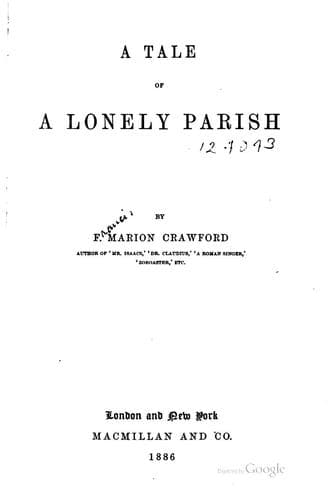
A Tale of a Lonely ParishCrawford, F. Marion (Francis Marion)
General
A Tale of a Lonely Parish
Crawford, F. Marion (Francis Marion)
Country life -- England -- Fiction; England -- Social life and customs -- Fiction
"No, I suppose not. Besides, fancy the vicar's state of mind! She would
have had to call him in to translate your poetry."
"It is very singular," said John in a tone of reflection. "But, if I had
not done all that, we should not be talking as we are now, after ten
minutes acquaintance."
"Probably not," said Mrs. Goddard.
"No--certainly not. By the bye, there is the Hall. I suppose you have
often been there since Mr. Juxon came--what kind of man is he?"
"He has been a great traveller," answered his companion. "And then--well,
he is a scholar and has an immense library--"
"And an immense dog--yes, but I mean, what kind of man is he himself?"
"He is very agreeable," said Mrs. Goddard quietly. "Very well bred, very
well educated. We find him a great addition in Billingsfield."
"I should think so, if he is all you say," said John discontentedly. His
antagonism against Mr. Juxon was rapidly increasing. Mrs. Goddard looked
at him in some surprise, being very far from understanding his tone.
"I think you will like him," she said. "He knows all about you from the
Ambroses, and he always speaks of you with the greatest admiration."
"Really? It is awfully kind of him, I am sure. I am very much obliged,"
said John rather contemptuously.
"Why do you speak like that?" asked Mrs. Goddard gravely. "You cannot
possibly have any cause for disliking him. Besides, he is a friend of
ours--"
"Oh, of course, then it is different," said John. "If he is a friend of
yours--"
"Do you generally take violent dislikes to people at first sight, Mr.
Short?"
"Oh, dear no. Not at all--at least, not dislikes. I suppose Mr. Juxon's
face reminds me of somebody I do not like. I will behave like an angel.
Here we are."
The effect of this conversation upon the two persons between whom it took
place was exceedingly different. Mrs. Goddard was amused, without being
altogether pleased. She had made the acquaintance of a refreshingly young
scholar whom she understood to be full of genius. He was enthusiastic,
simple, seemingly incapable of concealing anything that passed through
his mind, unreasonable and evidently very susceptible. On the whole, she
thought she should like him, though his scornful manner in speaking of
the squire had annoyed her. The interest she could feel in him, if she
felt any at all, would be akin to that of the vicar in the boy. He was
only a boy; brilliantly talented, they said, but still a mere boy. She
was fully ten years older than he--she might almost be his mother--well,
not quite that, but very nearly. It was amusing to think of his writing
odes to her. She wished she could see translations of them, and she
almost made up her mind to ask him to show them to her.
Public-domain text, read in full here on John Shaqi.
Reviews
Reviews
No reviews yet
Be the first to share your thoughts on this work.
Join the Discussion
Join the discussion
Sign in to leave a comment or review.
Sign InorCreate an account