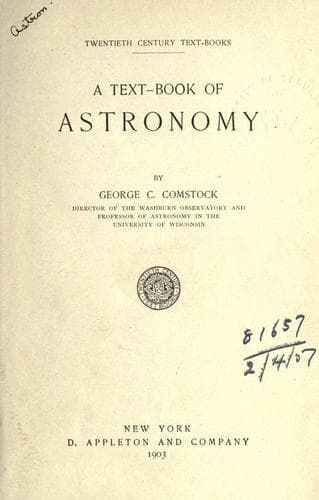
A Text-Book of AstronomyComstock, George C. (George Cary)
Science
A Text-Book of Astronomy
Comstock, George C. (George Cary)
Astronomy
_D_ = 103 days.
69/70 × _D_ × 4 = 406m.
= 6h. 46m.
_W_ = 4h. 0m.
_S_ = 10h. 46m.
The daily gain of sidereal upon mean solar time is 69/70 of 4 minutes,
and March 23d is the date on which sidereal and mean solar time are
together, taking the average of one year with another, but it varies a
little from year to year on account of the extra day introduced in leap
years.
RULE II. When the stars in the northern sky can be seen. Find β
Cassiopeiæ, and imagine a line drawn from it to Polaris, and another
line from Polaris to the zenith. The sidereal time is equal to the angle
between these lines, provided that that angle must be measured from the
zenith toward the west. Turn the angle from degrees into hours by
dividing by 15.
55. THE EARTH'S ROTATION.--We are familiar with the fact that a watch
may run faster at one time than at another, and it is worth while to
inquire if the same is not true of our chief timepiece--the earth. It is
assumed in the sections upon the measurement of time that the earth
turns about its axis with absolute uniformity, so that mean solar time
never gains or loses even the smallest fraction of a second. Whether
this be absolutely true or not, no one has ever succeeded in finding
convincing proof of a variation large enough to be measured, although it
has recently been shown that the axis about which it rotates is not
perfectly fixed within the body of the earth. The solid body of the
earth wriggles about this axis like a fish upon a hook, so that the
position of the north pole upon the earth's surface changes within a
year to the extent of 40 or 50 feet (15 meters) without ever getting
more than this distance away from its average position. This is probably
caused by the periodical shifting of masses of air and water from one
part of the earth to another as the seasons change, and it seems
probable that these changes will produce some small effect upon the
rotation of the earth. But in spite of these, for any such moderate
interval of time as a year or a century, so far as present knowledge
goes, we may regard the earth's rotation as uniform and undisturbed. For
longer intervals--e. g., 1,000,000 or 10,000,000 years--the question is
a very different one, and we shall have to meet it again in another
connection.
Public-domain text, read in full here on John Shaqi.
Reviews
Reviews
No reviews yet
Be the first to share your thoughts on this work.
Elsewhere in the archive
Join the Discussion
Join the discussion
Sign in to leave a comment or review.
Sign InorCreate an account