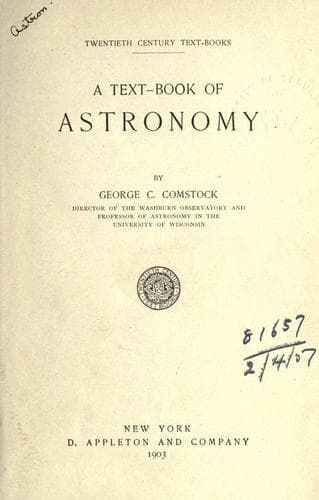
A Text-Book of AstronomyComstock, George C. (George Cary)
Science
A Text-Book of Astronomy
Comstock, George C. (George Cary)
Astronomy
A very ancient device was to call a year equal to 365 days, and to have
months alternately of 29 and 30 days in length, but this was
unsatisfactory in more than one way. At the end of four years this
artificial calendar would be about one day ahead of the true one, at the
end of forty years ten days in error, and within a single lifetime the
seasons would have appreciably changed their position in the year, April
weather being due in March, according to the calendar. So, too, the year
under this arrangement did not consist of any integral number of months,
12 months of the average length of 29.5 days being 354 days, and 13
months 383.5 days, thus making any particular month change its position
from the beginning to the middle and the end of the year within a
comparatively short time. Some peoples gave up the astronomical year as
an independent unit and adopted a conventional year of 12 lunar months,
354 days, which is now in use in certain Mohammedan countries, where it
is known as the wandering year, with reference to the changing positions
of the seasons in such a year. Others held to the astronomical year and
adopted a system of conventional months, such that twelve of them would
just make up a year, as is done to this day in our own calendar, whose
months of arbitrary length we are compelled to remember by some such
jingle as the following:
"Thirty days hath September,
April, June, and November;
All the rest have thirty-one
Save February,
Which alone hath twenty-eight,
Till leap year gives it twenty-nine."
61. THE CALENDAR.--The foundations of our calendar may fairly be
ascribed to Julius Cæsar, who, under the advice of the Egyptian
astronomer Sosigines, adopted the old Egyptian device of a leap year,
whereby every fourth year was to consist of 366 days, while ordinary
years were only 365 days long. He also placed the beginning of the year
at the first of January, instead of in March, where it had formerly
been, and gave his own name, Julius, to the month which we now call
July. August was afterward named in honor of his successor, Augustus.
The names of the earlier months of the year are drawn from Roman
mythology; those of the later months, September, October, etc., meaning
seventh month, eighth month, represent the places of these months in the
year, before Cæsar's reformation, and also their places in some of the
subsequent calendars, for the widest diversity of practice existed
during mediæval times with regard to the day on which the new year
should begin, Christmas, Easter, March 25th, and others having been
employed at different times and places.
Public-domain text, read in full here on John Shaqi.
Reviews
Reviews
No reviews yet
Be the first to share your thoughts on this work.
Elsewhere in the archive
Join the Discussion
Join the discussion
Sign in to leave a comment or review.
Sign InorCreate an account