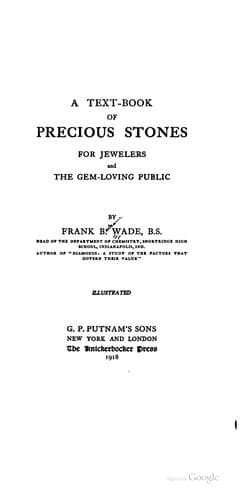
A Text-Book of Precious Stones for Jewelers and the Gem-Loving PublicWade, Frank Bertram
Science
A Text-Book of Precious Stones for Jewelers and the Gem-Loving Public
Wade, Frank Bertram
Precious stones
The many semi-precious stones which have a quartz basis (such as the
varieties of waxy or cryptocrystalline chalcedony which is largely
quartz in a very minutely crystalline condition) are often even tougher
than the clear crystallized quartz. Carnelian, agate, quartz cat's-eye,
jasper (containing earthy impurities), and those materials in which
quartz has more or less completely replaced other substances, such as
silicified crocidolite, petrified wood, chrysocolla quartz, etc., are
all nearly as hard and quite as tough as quartz itself, and they make
admirable stones for inexpensive rings of the arts and crafts type.
JADE. Jade, of the jadeite variety, which is rarer than the nephrite
jade, and more highly regarded by the Chinese, is an exceedingly tough
material. One can beat a chunk of the rough material with a hammer
without making much impression upon it. It is also fairly hard, about as
hard as quartz, and with the two properties of toughness and hardness it
possesses excellent wearing qualities in any kind of mounting. True
jade, whether jadeite or nephrite, deserves a larger use in inexpensive
ornaments, as it may be had of very fine green color and it is
inexpensive and durable.
SOFTER STONES. Coming next to those minerals whose hardness is 6 or
over, but less than 7, we have to consider jade of the nephrite variety,
demantoid garnet ("olivine" of the trade), peridot (or chrysolite, or
the olivine of the mineralogist), turquoise, moonstone, and opal.
As has already been said of jadeite, the jade of the nephrite variety,
while slightly less hard, is about as tough a mineral as one could
expect to find. It can take care of itself in any situation.
The demantoid garnet (the "olivine" of the trade) is so beautiful and
brilliant a stone that it is a pity that it is so lacking in hardness.
It will do very well for mounting in such jewels as scarf pins,
lavallières, etc., where but little hard wear is met with, but it cannot
be recommended for hard ring use.
The peridot, too, is rather soft for ring use and will last much better
in scarf pins or other mountings little subject to rubbing or to shocks.
Turquoise, although rather soft, is fairly tough, as its waxy luster
might make one suppose, and in addition, being an opaque stone, slight
dulling or scratching hardly lessens its beauty. It may therefore be
used in ring mountings. However, it should be suggested that most
turquoise is sufficiently porous to absorb grease, oil, or other
liquids, and its color is frequently ruined thereby. Of course, such a
change is far more likely to occur to a ring stone than to a turquoise
mounted in some more protected situation.
Public-domain text, read in full here on John Shaqi.
Reviews
Reviews
No reviews yet
Be the first to share your thoughts on this work.
Elsewhere in the archive
Join the Discussion
Join the discussion
Sign in to leave a comment or review.
Sign InorCreate an account