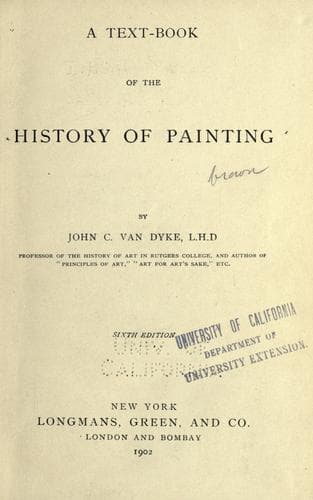
A Text-Book of the History of PaintingVan Dyke, John C.
History
A Text-Book of the History of Painting
Van Dyke, John C.
Painting -- History
The sculpturesque is characteristic of Mantegna's work. His people are
hard, rigid at times, immovable human beings, not so much turned to
stone as turned to bronze--the bronze of Donatello. There is little
sense of motion about them. The figure is sharp and harsh, the
drapery, evidently studied from sculpture, is "liney," and the
archaeology is often more scientific than artistic. Mantegna was not,
however, entirely devoted to the sculpturesque. He was one of the
severest nature students of the Early Renaissance, knew about nature,
and carried it out in more exacting detail than was perhaps well for
his art. In addition he was a master of light-and-shade, understood
composition, space, color, atmosphere, and was as scientific in
perspective as Piero della Francesca. There is stiffness in his
figures but nevertheless great truth and character. The forms are
noble, even grand, and for invention and imagination they were never,
in his time, carried further or higher. He was little of a
sentimentalist or an emotionalist, not much of a brush man or a
colorist, but as a draughtsman, a creator of noble forms, a man of
power, he stood second to none in the century.
Of Squarcione's other pupils Pizzolo (fl. 1470) was the most
promising, but died early. Marco Zoppo (1440-1498) seems to have
followed the Paduan formula of hardness, dryness, and exacting detail.
He was possibly influenced by Cosimo Tura, and in turn influenced
somewhat the Ferrara-Bolognese school. Mantegna, however, was the
greatest of the school, and his influence was far-reaching. It
affected the school of Venice in matters of drawing, beside
influencing the Lombard and Veronese schools in their beginnings.
SCHOOLS OF VERONA AND VICENZA: Artistically Verona belonged with the
Venetian provinces, because it was largely an echo of Venice except at
the very start. Vittore Pisano (1380-1456), called Pisanello, was the
earliest painter of note, but he was not distinctly Veronese in his
art. He was medallist and painter both, worked with Gentile da
Fabriano in the Ducal Palace at Venice and elsewhere, and his art
seems to have an affinity with that of his companion.
Liberale da Verona (1451-1536?) was at first a miniaturist, but
afterward developed a larger style based on a following of Mantegna's
work, with some Venetian influences showing in the coloring and
backgrounds. Francesco Bonsignori (1455-1519) was of the Verona
school, but established himself later at Mantua and was under the
Mantegna influence. His style at first was rather severe, but he
afterward developed much ability in portraiture, historical work,
animals, and architectural features. Francesco Caroto (1470-1546), a
pupil of Liberale, really belongs to the next century--the High
Renaissance--but his early works show his education in Veronese and
Paduan methods.
[Illustration: FIG. 34.--B. VIVARINI. MADONNA AND CHILD. TURIN.]
Public-domain text, read in full here on John Shaqi.
Reviews
Reviews
No reviews yet
Be the first to share your thoughts on this work.
Join the Discussion
Join the discussion
Sign in to leave a comment or review.
Sign InorCreate an account