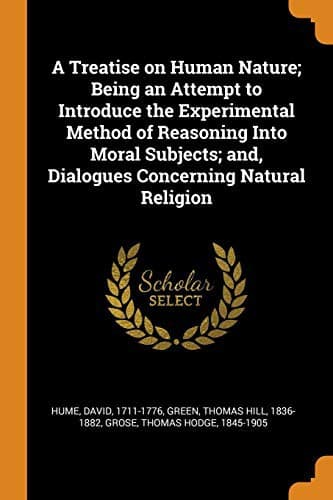
A Treatise of Human Nature: Being an Attempt to Introduce the Experimental Method Into Moral Subjects; and Dialogues Concerning Natural Religion — John Shaqi
A Treatise of Human Nature: Being an Attempt to Introduce the Experimental Method Into Moral Subjects; and Dialogues Concerning Natural ReligionHume, David
PhilosophyPhilosophy
A Treatise of Human Nature: Being an Attempt to Introduce the Experimental Method Into Moral Subjects; and Dialogues Concerning Natural Religion
Hume, David
Emotions; Ethics; Knowledge, Theory of; Philosophy, English
In the process by which we are supposed to arrive at complex ideas of
substances the beginning is the same as the end.
39. The same paralogism appears under a slightly altered form when
it is stated (in the first letter to Stillingfleet) that the idea
of substance as the ‘general indetermined idea of _something_ is
by the abstraction of the mind derived from the simple ideas of
sensation and reflection.’ Now ‘abstraction’ with Locke means the
‘separation of an idea from all other ideas that accompany it in its
real existence.’ (Book II. chap. xii. sec. 1.) It is clear then that
it is impossible to abstract an idea which is not _there_, in real
existence, to be abstracted. Accordingly, if the ‘general idea of
something’ is derived by abstraction from simple ideas of sensation
and reflection, it must be originally given with these ideas, or it
would not afterwards be separated from them. Conversely they must
carry this idea with them, and cannot be simple ideas at all, but
compound ones, each made up of ‘the general idea of something or
being,’ and of an accident which this something supports. How then
does the general idea of substance or ‘something,’ _as derived_,
differ from the idea of ‘something,’ as given in the original ideas
of sensation and reflection from which the supposed process of
abstraction starts? What can be said of the one that cannot be said
of the other? If the derived general idea is of something related
to qualities, what, according to Locke, are the original ideas
but those of qualities related to something? It is true that the
general idea is of something, of which nothing further is known,
related to qualities in general, not to any particular qualities.
But the ‘simple idea’ in like manner can only be of an indeterminate
quality, for in order to any determination of it, the idea must be
put together with another idea, and so cease to be simple; and the
‘something,’ to which it is referred, must for the same reason be
a purely indeterminate something. If, in order to avoid concluding
that Locke thus unwittingly identified the abstract general idea of
substance with any simple idea, we say that the simple idea, because
not abstract, is not indeterminate but of a real quality, defined
by manifold relations, we fall upon the new difficulty that, if so,
not only does the simple idea become manifoldly complex, but just
such an ‘idea of a particular sort of substance’ as, according to
Locke, is derived from the derived idea of substance in general. As
an idea of a quality, it is also necessarily an idea of a correlative
‘something;’ and if it is an idea of a quality in its reality, _i.e._
as determined by various relations, it must be an idea of a variously
qualified something, _i.e._ of a particular substance. Then not
merely the middle of the twofold process by which we are supposed
to get at ‘complex ideas of substances’--_i.e._ the _abstract_
something; but its end--_i.e._ the _particular_ something--turns out
Public-domain text, read in full here on John Shaqi.
Reviews
Reviews
No reviews yet
Be the first to share your thoughts on this work.
Join the Discussion
Join the discussion
Sign in to leave a comment or review.
Sign InorCreate an account