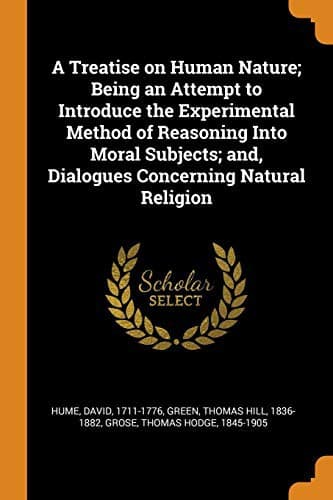
A Treatise of Human Nature: Being an Attempt to Introduce the Experimental Method Into Moral Subjects; and Dialogues Concerning Natural ReligionHume, David
PhilosophyPhilosophy
A Treatise of Human Nature: Being an Attempt to Introduce the Experimental Method Into Moral Subjects; and Dialogues Concerning Natural Religion
Hume, David
Emotions; Ethics; Knowledge, Theory of; Philosophy, English
to be the same as its beginning.
Doctrine of abstraction inconsistent with doctrine of complex ideas.
40. The fact is, that in making the general idea of substance precede
particular ideas of sorts of substances (as he certainly however
confusedly does, in the 23rd chapter of the Second Book, [1] as well
as by implication in his doctrine of modes. Book II. chap. xii.
sec. 4), Locke stumbled upon a truth which he was not aware of, and
which will not fit into his ordinary doctrine of general ideas: the
truth that knowledge is a process from the more abstract to the more
concrete, not the reverse, as is commonly supposed, and as Locke’s
definition of abstraction implies. Throughout his prolix discussion
of ‘substance’ and ‘essence’ we find two opposite notions perpetually
cross each other: one that knowledge begins with the simple idea,
the other that it begins with the real thing as particularized by
manifold relations. According to the former notion, simple ideas
being given, void of relation, as the real, the mind of its own act
proceeds to bring them into relation and compound them: according
to the latter, a thing of various properties (_i.e._ relations [2])
being given as the real, the mind proceeds to separate these from
each other. According to the one notion the intellectual process, as
one of complication, ends just where, according to the other notion,
as one of abstraction, it began.
[1] See above, paragraph 35.
[2] Cf. Book II. chap, xxiii. sec. 37. Most of the simple ideas that
make up our complex ideas of substances are only powers ... _e.g._
the greater part of the ideas which make up our complex idea of gold
... are nothing else _but so many relations to other substances_.’
The confusion covered by use of ‘particulars’.
41. The chief verbal equivocation, under which Locke disguises the
confusion of these two notions, is to be found in the use of the
word ‘particular,’ which is sometimes used for the mere individual
having no community with anything else, sometimes for the thing
qualified by relation to a multitude of other things. The simple idea
or sensation; the ‘something’ which the simple idea is supposed to
‘report,’ and which Locke at his pleasure identifies with it; the
complex idea; and the thing as the collection of the properties which
the simple idea ‘reports,’ all are merged by Locke under the one term
‘particulars.’ As the only consistency in his use of the term seems
to lie in its opposition to ‘generals,’ we naturally turn to the
passage where this opposition is spoken of most at large.
Locke’s account of abstract general ideas.
Public-domain text, read in full here on John Shaqi.
Reviews
Reviews
No reviews yet
Be the first to share your thoughts on this work.
Join the Discussion
Join the discussion
Sign in to leave a comment or review.
Sign InorCreate an account